A monumental limestone observatory holds mechanically supported aged-brass orbital rings above a stone terrestrial sphere, opening onto an evening landscape.

Policy Lab / Space exploration & development

The SPACE
Act of 2026.

The capacity to discover.
The responsibility to endure.

Model legislation · No introduction or enactment established

Scientific Progress, Autonomy, Capacity, and Exploration

A proposed $309.748 billion annual science system connecting NASA and DARPA to fundamental research, shared facilities, skilled people, open knowledge, responsible technology, and international cooperation.

Legislative titles
39
Operative sections
445
Supporting annexes
11
Proposed annual authority
$309.748B

Constant FY2025 dollars · No official budget score · Foundation analysis dated October 27, 2026

Document & filing details
Bill
TTF-SPACE-2026 · internal Foundation docket
Sponsor
No congressional sponsor identified in the supplied package
Congress
Model U.S. federal legislation; no official bill number established
Committee referral
Potential jurisdiction includes science and space, armed services, appropriations, tax, judiciary, and affected committees; no official referral claimed
Filing date
Not filed; Foundation analysis published October 27, 2026
Submission contents
Complete supplied SPACE Act, annexes A–K, independent Foundation analysis, primary-source register, reproducible calculations and source integrity record

39 titles · 445 operative sections · 11 source annexes. Internal Foundation record; no official congressional assignment is claimed.

A guide to this proposal

Start with the idea.
Go as deep as you need.

If enacted, the Act would provide the full indexed annual funding schedule through permanent appropriations and a Treasury backstop. Tax receipts would offset financing, while project readiness would govern commitments and delivery. The proposal has no official fiscal score, and its reserve and endowment targets are not funded assets.

Scientific capacityPermanent appropriationsIndependent researchResponsible explorationTechnical workforceOpen scienceInternational cooperationFuture generations
Document architecture
39 titles · 445 operative sections · 11 source annexes
Complete source text
37,288 words

Analysis is commentary. Model text is a proposal. Fiscal scenarios, where provided, are illustrative.

Foundation Analysis

Scientific capacity requires people, institutions, and accountable finance.

The SPACE Act proposes a permanent public-science system rather than a single exploration mission. Its eight-account schedule reconciles and its readiness, scientific-integrity and knowledge-preservation provisions address real institutional needs. The scale, financing and several legal mechanisms still require independent scoring and precise statutory integration.

In plain language: If enacted, the Act would provide the full indexed annual funding schedule through permanent appropriations and a Treasury backstop. Tax receipts would offset financing, while project readiness would govern commitments and delivery. The proposal has no official fiscal score, and its reserve and endowment targets are not funded assets.

01

One reconciled statutory schedule

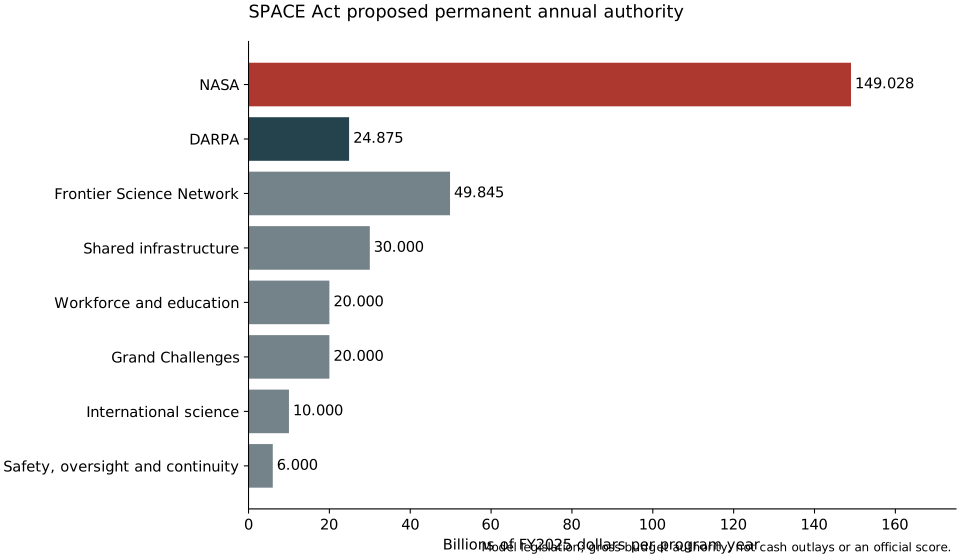
The eight accounts total $309.748B annually in FY2025 purchasing power. NASA receives $149.028B and DARPA $24.875B, included in that total. Qualifying ordinary agency appropriations count once; the other six accounts total $135.845B.

02

Appropriated authority, uncertain net cost

The proposed Treasury backstop would preserve program authority when dedicated receipts fall short. It cannot establish deficit neutrality. Outlays, tax interactions, borrowing costs, current-law appropriations and capitalization require a proposal-specific CBO/JCT score.

03

Readiness governs delivery

Full budget authority would begin in the first full fiscal year under §3910. Capital gates, trained supervisors, contracting staff, utilities, independent tests and maintenance plans would determine when commitments and payments can responsibly occur.

04

Long-horizon targets need assets

The $434.7575B reserve and $15.4874T endowment are capitalization goals. Neither is financed automatically by the annual operating schedule. Five-century stewardship is a review duty, not a guarantee of future returns, institutions or scientific results.

Foundation assessment

The proposal offers a coherent public-capacity agenda with useful safeguards for scientific independence, informative failure, open knowledge and lifecycle stewardship. Its spending scale is a policy choice whose affordability and absorptive capacity have not been demonstrated. Advance it through independent fiscal scoring, a conforming statutory crosswalk, correction of the identified drafting defects, and credible workforce and capital plans.

Independent Foundation analysis dated October 27, 2026. Model legislation; no official introduction, enactment, agency endorsement or CBO/JCT score established. The uploaded document is preserved byte for byte. Calculations illustrate the proposal and explicit assumptions; they are not forecasts.

02 / Policy mechanisms

A public system for discovery.

The proposed law connects funding and scientific freedom to practical delivery, public knowledge and long-term responsibilities.

01

Titles II, IV and XXXI

A permanent annual funding compact

Eight indexed accounts would receive $309.748B in FY2025 purchasing power from the first full program fiscal year.

NASA and DARPA ordinary appropriations count toward their floors. The Treasury supplies the balance; weak tax receipts do not automatically shrink the program.

02

Titles III, VII, IX and XXIX

Scientific autonomy with public accountability

Technical conclusions, dissent, peer review, test evidence and lawful publication would receive protection while elected officials retain mission and budget powers.

High-risk failure is acceptable when informative and well managed. Fraud, unsafe conduct, capture and falsified results remain subject to oversight.

03

Titles V, XXXII and XXXIV

Facilities that can operate for their full lives

A scientific infrastructure authority would support laboratories, instruments, launch utilities, computing and renewal.

Design, science value, independent cost, labor, power, water, environmental review, commissioning, maintenance and decommissioning gates precede major construction.

04

Titles VI–XIX and XXXV

A plural science and technology portfolio

NASA and DARPA would sit alongside investigator-led science, observatories, computing, energy, materials, biotechnology, Earth observations and far-horizon research.

The $6B far-horizon allocation sits inside the $20B Grand Challenges account. Unproven propulsion and other extraordinary claims need testable evidence before scale.

05

Titles XX–XXVII, XXXIII and XXXVII

People and reusable public knowledge

Paid apprenticeships, research fellowships, technical careers, lawful talent mobility, public data, software and archives would support the science workforce.

The Act does not create a new visa category. Publication, privacy, independent safety, security review and rights remedies need coordinated implementing rules.

06

Titles XXVIII, XXXVI, XXXVIII; Annexes F–G

International and intergenerational stewardship

Voluntary international facilities, common programs and optional subscriptions would support shared peaceful science.

Domestic constitutional processes, appropriations, host-state law and treaty duties remain applicable. The 500-year horizon is a recurring planning exercise.

03 / Fiscal analysis

How the funding would work.

An annual appropriation, a liquidity target and an endowment target serve different purposes. Only the annual schedule is proposed recurring program authority.

Annual program authority$309.748B

Full proposed authority each program year, indexed from FY2025. Cash payments would follow actual obligations and delivery.

Reserve asset target$434.7575B

Thirty months of the $173.903B combined NASA and DARPA floors. No funded starting balance is assumed.

Endowment asset target$15.4874T

Fifty times annual authority. Requires separately lawful capitalization; no investment return is guaranteed.

The annual allocation

Eight accounts.
One science system.

NASA and DARPA together receive $173.903B. The other six accounts total $135.845B, connecting discovery to facilities, people, cooperation and oversight.

The $6B far-horizon allocation is included in the $20B Grand Challenges account and satisfies §1003’s $5B minimum. Nested floors and suballocations are not extra appropriations.

Download the funding chart ↓
Statutory account schedule · billions of FY2025 dollars · §3110
ComponentAnnual amountShare
NASA$149.028B48.1%
DARPA$24.875B8.0%
Frontier Science Network$49.845B16.1%
Shared infrastructure$30.000B9.7%
Workforce and education$20.000B6.5%
Grand Challenges$20.000B6.5%
International science$10.000B3.2%
Safety, oversight and continuity$6.000B1.9%
Total$309.748B100%

How ordinary appropriations and taxes interact

Sections 213–216 and 401 would provide a permanent Treasury backstop. Qualifying current-year NASA and DARPA ordinary appropriations count toward their floors once; dedicated receipts reduce general-fund financing. Most other agencies’ ordinary budgets remain outside the new complementary accounts. Tax underperformance would increase the Treasury transfer rather than automatically reduce the program.

If qualified ordinary agency appropriations equaled the historical FY2025 comparators of $24.838B and $4.145693B on a consistent price basis, the authority difference would be $280.764307B before dedicated receipts. This is a conditional accounting comparison, not the current-law baseline, an outlay estimate or the net deficit effect. NASA’s comparator is verified; DARPA’s exact input remains source-stated because its cited official file was inaccessible.

Proposed dedicated levies · §§403–404
Tax baseStatutory rateQualification
Covered equity and pooled-security acquisitions0.06%Secondary markets; exemptions, intermediary relief and behavioral response matter.
Covered debt acquisitions0.02%Short maturities and other statutory exclusions apply.
Covered derivativesEquivalence amount, not a stated flat notional rateValuation and taxable payments need detailed tax drafting.
Qualifying §4501 stock repurchasesAdditional 1%On the statutory net base; existing 1% levy remains separate.

CBO’s $296.8B estimate is cumulative deficit reduction over 2025–2034 for a different 0.01% transaction tax. It supplies context, not a score of this bill. Rates, base definitions, relief, tax interactions, timing, avoidance and household incidence prevent linear scaling.

Full authority begins in the first full program year

Section 3910 sets a general effective date 180 days after enactment, with the annual schedule beginning the following October 1. Section 3004 expressly provides full first-year authority. Commitments and payments still depend on readiness, procurement and project delivery. No enactment date or calendar starting fiscal year is assumed here.

Mechanical gross authority · no receipts, outlay schedule, interest or capitalization
Full program yearsConstant FY2025-dollar authority
1$309.748B
5$1,548.740B
10$3,097.480B
30$9,292.440B

Ten full schedules equal $3.09748T of gross authority. The 500-year multiplication is $154.874T; it is scale arithmetic, not a fiscal forecast, present value or guarantee. The common GDP index would determine nominal authority under a clarified §206 rule.

What capitalization requires

A flat twenty-year reserve build from zero would require $21.737875B a year with no return or withdrawals. That is additional asset accumulation, not another appropriation already supplied by the operating schedule. The reserve equals 16.84 months of the full eight-account schedule; its statutory benchmark covers only NASA and DARPA.

Ordinary distributions may begin after principal reaches 25× annual authority. If the trailing-five-year real average also equals 25×, the 2% ceiling supplies $154.874B, half of annual authority. With a 50× average, 2% equals $309.748B. Neither identity establishes a sustainable real return. A 30% asset loss would make a payout based on an unrevised pre-loss average equal 2.86% of remaining principal.

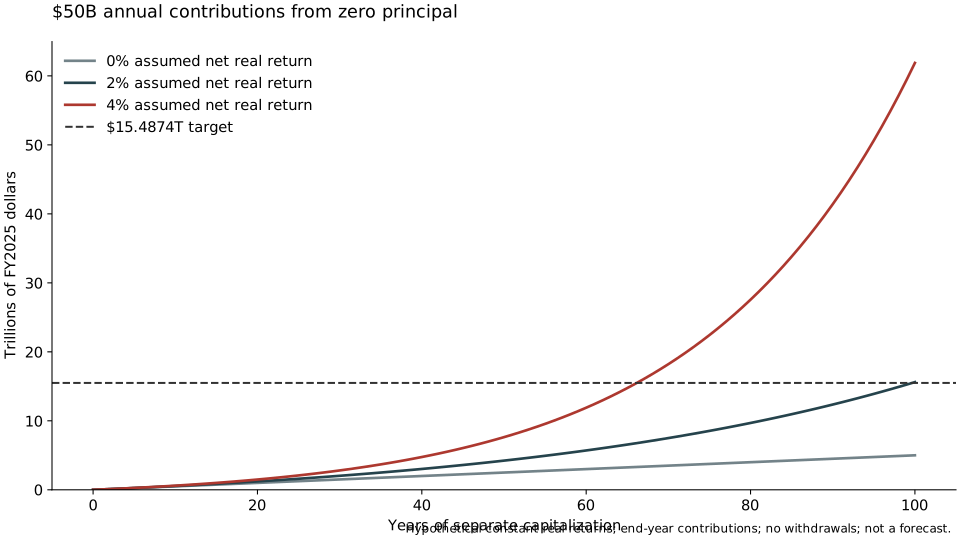
image/svg+xml Matplotlib v3.11.2, https://matplotlib.org/ 0 20 40 60 80 100 Years of separate capitalization 0 10 20 30 40 50 60 Trillions of FY2025 dollars $50B annual contributions from zero principal 0% assumed net real return 2% assumed net real return 4% assumed net real return $15.4874T target Hypothetical constant real returns; end-year contributions; no withdrawals; not a forecast.
Hypothetical accumulation with no distributions. Reserve capitalization, debt cost and volatile returns require separate analysis.
Whole years to the $15.4874T target from zero principal
Annual separate contribution0% net real return2% net real return4% net real return
$25.000B62013283
$50.000B31010067
$100.000B1557251

Contributions and returns are assumptions. Program costs, Treasury financing, reserve assets, endowment assets and debt liabilities must be reconciled separately. A Treasury security held by a federal fund is not net wealth newly created for the consolidated government.

04 / Interactive calculations

Test explicit assumptions.

Change explicit assumptions to examine financing and capital accumulation. Transaction bases, available ordinary appropriations and investment returns below are hypothetical inputs. No empirical taxable base or official score is supplied.

Treasury financing illustration

The tax rates are fixed by the proposal: 0.06% for covered equity and pooled-security acquisitions, and 0.02% for covered debt acquisitions. Effective bases mean transactions remaining after exemptions and behavioral response. Derivatives need separate valuation.

Defaults illustrate the historical FY2025 comparators, not actual appropriations in a future program year. DARPA’s exact comparator remains source-stated and unverified. Counted authority is capped at each agency floor.

Default zero. Any derivatives-equivalence receipts, additional buyback contribution, fees or royalties must be estimated separately. Existing buyback-tax receipts and reserve draws cannot be counted as this recurring new revenue.

Gross annual program authority
$309.748B
Assumed ordinary agency authority counted once
$28.983693B
Authority difference before dedicated receipts
$280.764307B
Hypothetical dedicated receipts
$0.000B
Illustrative remaining general-fund transfer
$280.764307B
Receipts above this modeled financing gap
$0.000B

Inputs share a price level and accounting period. This is a simplified transfer reconciliation, not a cash spendout model. Receipts above the gap do not become automatic endowment principal; obligations, account availability and the asset waterfall still govern.

The Treasury backstop preserves proposed program authority. This illustration does not establish deficit neutrality.

Receipts in billions = equity base in trillions × 0.6 + debt base in trillions × 0.2 + other receipts. General-fund transfer = max(0, $309.748B − qualified ordinary agency authority − dedicated receipts). The whole-government fiscal effect also requires spendout, current-law baseline, other-tax interactions, administration and interest.

Build the endowment

Assume separate lawful capitalization from zero principal, fixed end-of-year contributions and a constant net real return after fees. No payouts occur during this example, and reserve requirements remain separate.

This does not simulate the statutory trailing-average payout rule, returns risk or funding waterfall. A negative constant return can make the target unreachable.

Principal after 50 years
$4.229T
Share of the $15.4874T target
27.3%
Whole years to target
100 years

Pₙ = C × ((1 + r)ⁿ − 1) ÷ r; when r = 0, Pₙ = C × n. Changing contributions, market losses, program growth and withdrawals can delay or prevent capitalization.

05 / Primary evidence

What the evidence supports.

01

NASA’s recurring comparator is supported

$24.838B is the recurring FY2025 discretionary comparator reported in NASA’s own financial statements. All-in special and supplemental funding is a different measure. Multiplying the recurring comparator by six yields the proposed $149.028B NASA account.

02

DARPA’s exact comparator remains unverified

The source states enacted FY2025 RDT&E of $4.145693B. The linked official justification returned access errors, including HTTP 403. The proposed $24.875B is $842,000 above six times that input, but the input’s exact classification has not been independently checked.

03

Workforce and facility constraints are documented

GAO reports substantial NASA workforce losses and staffing effects on 25 of 36 major projects. NASA OIG identifies aging common-use infrastructure and possible Kennedy and Wallops operational capacity limits in 2028–2029. These findings support readiness controls; they do not validate the bill’s allocation size.

04

A tax benchmark cannot score this proposal

CBO’s different 0.01% transaction-tax option produced an estimated $296.8B cumulative deficit reduction over 2025–2034. It is not annual yield and cannot be multiplied by the SPACE rates to estimate this bill. Its base, timing, exemptions and behavioral effects differ.

05

The stock-repurchase addition has its own base

The examined code imposes an existing 1% excise with netting and exceptions. Section 404 would add another 1% on the qualifying base. Only the additional contribution is dedicated here; gross announced repurchases are not the net taxable base.

06 / Legal and institutional review

Decisions before introduction.

These are independent Foundation findings and recommended drafting decisions. They do not alter the supplied legislation or represent an opinion of congressional counsel. A savings clause can preserve existing law without resolving every implementing conflict.

01 / Material fiscal uncertainty

Obtain a proposal-specific fiscal score

§§213–216, 401–406, 3902

The permanent appropriation would provide legal authority if enacted, while the Treasury bears financing shortfalls. Score new budget authority, actual outlays, current-law agency funding, net tax interactions, administrative costs, credit subsidies and interest. Neither the statutory total nor the CBO comparator proves affordability or deficit neutrality.

02 / Before introduction

Complete the fixed-rate tax provisions

§§403–404, 415, 3903

Specify liable persons, securities and derivative valuation, intermediary relief, cross-border nexus, taxable events, refunds, penalties, collection dates and Internal Revenue Code integration. Treasury cannot increase the stated rates to fill a gap. Household, pension, liquidity, avoidance and international substitution effects need a JCT estimate.

03 / Before introduction

Separate investment capital from program financing

§§402(b)–(c), 407–408, 413, 3805

All receipts offset Treasury transfers, yet receipts above current obligations are also directed toward assets. Current-year cash not yet paid may support unexpired multiyear program commitments. Define a single waterfall protecting liabilities and availability before labeling money excess. Specify separately lawful reserve and endowment capitalization; do not double count the operating appropriation.

04 / Before introduction

Resolve the three-times purpose language

§102(2), compared with §§201–202

The purpose clause retains a minimum of three times FY2025 funding, while the operative agency amounts are approximately six times. A three-times minimum is mathematically compatible with six-times funding, but it obscures the operative policy. Align the purpose text through a legislative correction. The published source remains unchanged.

05 / Before introduction

Correct the convention annex reference

§2802(a); Annexes A and F

Section 2802 points to Annex A as the international convention. Annex A contains research and verification material; the convention is in Annex F. Correct the cross-reference before introduction. Annex commentary cannot silently repair the operative provision.

06 / Before introduction

Clarify appointments and executive supervision

§§304, 409, 501–502, 802, 1001

The Fund’s seven appointed trustees use presidential nomination and Senate consent. The separate Infrastructure Authority board uses agency representatives and presidentially appointed experts without comparable detail. Define officer status, appointment routes, delegations, supervisory authority, removal, vacancies, quorum and a responsible executive. Advisory bodies must stay advisory unless validly constituted for operative powers.

07 / Before introduction

Harmonize account availability and appropriation clauses

§§203–205, 209, 213, 401(b), 3110

Ordinary research and fellowship funds have five-year availability under §209; capital funds remain available until expended. Section 401 uses broad no-year language. Clarify which rule controls each account, when time starts, and how the several appropriation clauses constitute one schedule. Reconcile ordinary NASA/DARPA funds before top-ups and preserve fiscal-year origin.

08 / Before introduction

Specify an executable price-index rule

§206; §3102

Section 206(b) already calls for the most recently available index estimate and a following-year true-up. BEA publishes observed GDP price indexes, while certification is due 120 days before the future fiscal year begins. Specify who supplies that advance estimate, fiscal-year aggregation, forecast or lag methodology, data vintage, rounding and account-level reconciliation. The existing true-up direction needs implementing detail.

09 / Before introduction

Make early implementation deadlines fundable

§§3002–3004, 3910, 3914

The general effective date is 180 days after enactment and the full annual schedule begins the following October 1. Some 90-day, 120-day and one-year institutional tasks start earlier. Section 3910 permits preparation only from otherwise available appropriations. Map each deadline to a legal start date, responsible agency, available administrative funding and predecessor authority. There is no reduced-funding statutory ramp.

10 / Before introduction

Remove the dangling immigration reference

§§2201–2203, 2209, 3310, 3608

The bill expressly creates no new visa class and preserves existing numerical limits, but §2209 refers to classifications established by the Act. Align that clause with the actual limited sponsor-process authority. New visas, admissions guarantees or numerical changes need express immigration legislation. Do not advertise an immediate new immigration pathway.

11 / Before introduction

Translate readiness conditions into enforceable workflows

§§211, 501, 510, 3003; Titles XXXII–XXXIV

The §211 trigger compares an allocation with twice actual annual obligations; it is not a percentage-growth trigger. Specify the comparator year, covered commitments, certification owner, evidence, appeals and public reporting. Coordinate $100M records, $250M lifecycle estimates, $500M commitments and above-$1B technical verification so that split projects cannot evade review.

12 / Before introduction

Define civilian procurement and personnel integration

§§2001–2007, 2304, 2309, 2313

Broad pay and acquisition directions need agency-specific legal crosswalks, caps, appointment limits and instrument safeguards. Section 2304’s new civilian transaction authority needs an administrable scope, designated officials, audit and challenge process. Defense transactions retain applicable title 10 conditions. Speed targets cannot replace lawful competition or safety.

13 / Before introduction

Fund rights enforcement and independent safety

§§303, 312, 2501–2502, 2601–2614; Titles XXXVII and XXXIX

The text protects dissent, publication, human subjects, privacy and safety, and includes data minimization. Assign independent reviewers, deadlines, written reasons and appeal routes. Section 3907 generally creates no new private action or monetary remedy, so savings clauses alone do not ensure a practical remedy. Maintain lawful existing protections and qualified jurisdiction-specific review.

14 / Before introduction

Reconcile IP and scale-up support with existing law

§§2404–2408, 2411, 2505, 3701

Mission licenses, open tools, royalties, warrants and data escrow can protect public value, but require precise agreement terms and conforming treatment of existing patent, inventor, royalty and proprietary-data rights. Loans and guarantees require separate credit authority and subsidy scoring. Do not count projected royalties as assured financing.

15 / Before introduction

Set project-specific international and space responsibilities

Titles XXVIII, XXXV–XXXVI; §§3911–3912

No domestic appropriation binds foreign partners, transfers sovereign powers, awards celestial territory or supplies another regulator’s operational approval. Define governing agreements, U.S. authority, host law, liability, export controls, safety, withdrawal and closure finance before commitments. The treaty route and review requirements depend on the actual instrument.

16 / Ongoing evaluation

Demonstrate benefits and monitor crowding and capture

§§2901, 2908–2912, 3118; Annex H

Funding can support research access, reliable facilities and talent, but also bid up scarce labor, construction and specialized suppliers. Track instrument queues, scientific diversity, procurement concentration, maintenance, replication and outcomes against a baseline. No supported estimate here establishes net jobs, GDP gains, mission success rates or a bill-wide benefit-cost ratio.

07 / Complete statutory coverage

All 39 titles, examined.

This map covers all 445 operative sections. Each entry distinguishes the proposed function from the implementation question. Use the full-text reader below to examine the actual provisions.

Title I / 9 sections

General framework

§§101–109

Public-science purposes and mission boundaries, with no promised scientific result.

Implementation review. Align the three-times purpose clause with the operative sixfold agency schedule.

Title II / 17 sections

Funding compact

§§201–217

Eight annual accounts, common indexing, counted agency appropriations and full Treasury-backed authority.

Implementation review. Resolve availability, index timing and current-year crosswalks; distinguish authority from spending.

Title III / 12 sections

Scientific autonomy

§§301–312

Technical findings, dissent, peer review and publication receive protection within lawful policy supervision.

Implementation review. Assign independent appeals and enforceable procedures without insulating executive powers.

Title IV / 16 sections

Future Fund and finance

§§401–416

Fixed excises, Treasury financing, separate reserve and endowment goals, and public accounting.

Implementation review. Complete tax rules and a capital waterfall; obtain a net fiscal score.

Title V / 14 sections

Scientific infrastructure

§§501–514

A government corporation, facilities, scientific land planning and lifecycle renewal.

Implementation review. Specify appointments, oversight and operator responsibilities; require ready sites and utilities.

Title VI / 12 sections

NASA capacity

§§601–612

Balanced civilian portfolios, independent estimates, workforce restoration and science competition.

Implementation review. Test mission and center plans against actual capacity and scientific priorities.

Title VII / 11 sections

DARPA capacity

§§701–711

Program-manager leadership, limited terms, informative failure and independent validation.

Implementation review. Scale performers and test capacity while preserving defense transaction conditions.

Title VIII / 10 sections

Frontier Science Network

§§801–810

Institutionally plural research coordination, metrology, software and shared facilities.

Implementation review. Make agency agreements and ordinary-budget distinctions explicit.

Title IX / 8 sections

Fundamental science

§§901–908

Investigator-led research, major instruments, replication and long-duration observations.

Implementation review. Apply nested research and verification floors without counting them as additional accounts.

Title X / 9 sections

Grand Challenges

§§1001–1009

Testable moonshots, small concept awards, prizes, far-horizon work and termination pathways.

Implementation review. The $6B schedule allocation meets the $5B far-horizon floor; preserve methodological standards.

Title XI / 9 sections

Deep-space systems

§§1101–1109

Cislunar services, lunar science, Mars concepts, communications and planetary protection.

Implementation review. Require architecture, logistics, safety and lifecycle evidence rather than assume feasibility.

Title XII / 8 sections

Space science disciplines

§§1201–1208

Observatory continuity, planetary science, heliophysics, life detection and instrument access.

Implementation review. Use credible mission sequencing, independent priorities and long-lived data plans.

Title XIII / 7 sections

Aeronautics

§§1301–1307

Civil flight research, aviation data, mobility testing and sustainable aviation science.

Implementation review. Coordinate actual flight and environmental approvals with independent validation.

Title XIV / 11 sections

Computing and AI

§§1401–1411

Shared compute, quantum, robotics, research software and autonomous laboratories.

Implementation review. Plan electricity, refresh cycles, scientific access, reproducibility and qualified safety testing.

Title XV / 9 sections

Energy and materials

§§1501–1509

Energy experiments, manufacturing, microelectronics, critical materials and instruments.

Implementation review. Use test-before-scale evidence, supplier readiness and project-specific licensing.

Title XVI / 8 sections

Biology and life support

§§1601–1608

Space medicine, closed-loop life support, biomanufacturing and capability-based biosecurity.

Implementation review. Preserve informed consent, containment and independent release assessment.

Title XVII / 8 sections

Earth and environment

§§1701–1708

Earth, ocean, polar, atmospheric and hazard observations with data continuity.

Implementation review. Maintain calibration, field access and irreplaceable observation series.

Title XVIII / 8 sections

Planetary defense and resilience

§§1801–1808

Hazard detection, space weather, scientific warning and continuity exercises.

Implementation review. Define operational responsibility; funding creates no general emergency or police power.

Title XIX / 9 sections

Propulsion and in-space industry

§§1901–1909

Propulsion research, servicing, resource experiments and interstellar precursors.

Implementation review. Independent measurements and replication precede costly scale-up; no travel outcome is guaranteed.

Title XX / 14 sections

Federal workforce

§§2001–2014

Scientific personnel authorities, technical careers, mobility, support occupations and retention.

Implementation review. Integrate civil-service and pay law, conflicts and real supervisory capacity.

Title XXI / 12 sections

Education and apprenticeships

§§2101–2112

Paid technical pathways, fellowships, teacher placements and public scientific access.

Implementation review. Specify participant protections, service terms and measurable placement and retention.

Title XXII / 9 sections

Global scientific talent

§§2201–2209

Sponsor-process coordination and research mobility within existing immigration law.

Implementation review. No new visa is created; correct the dangling classifications clause.

Title XXIII / 14 sections

Research acquisition

§§2301–2314

Instrument choice, simplified experiments, milestones, transaction powers and fair selection.

Implementation review. Define lawful civilian authority and remedies; preserve applicable defense and fiscal conditions.

Title XXIV / 11 sections

Technology transition and public return

§§2401–2411

First customers, pilot facilities, standards, licenses, scale-up finance and mission continuity.

Implementation review. Score credit programs separately and reconcile patents, royalties and data rights.

Title XXV / 11 sections

Open science and archives

§§2501–2511

Publication, reproducible software, negative results, data escrow and archive succession.

Implementation review. Give restrictions a legal basis, expiry and appeal; protect sensitive data and ongoing maintenance.

Title XXVI / 14 sections

Safety and civil liberties

§§2601–2614

Human subjects, dual-use tiers, privacy, dissent, security and stop-work duties.

Implementation review. Provide qualified independent reviewers and practical procedures under applicable law.

Title XXVII / 11 sections

Regional science capacity

§§2701–2711

Regional research corridors, smaller suppliers, tribal partnerships and local infrastructure.

Implementation review. Avoid capacity without maintenance or selection by political favoritism.

Title XXVIII / 16 sections

International compact

§§2801–2816

Negotiation, common and optional programs, host duties and sovereign authority savings.

Implementation review. Correct Annex A to Annex F and review each agreement’s constitutional route.

Title XXIX / 12 sections

Oversight and anti-capture

§§2901–2912

Independent estimates, stage gates, dashboards, IG/GAO review and outcome evaluation.

Implementation review. Measure learning and delivered capability, audit definitions and consolidate duplicative reporting.

Title XXX / 13 sections

Implementation

§§3001–3013

Early inventories, a temporary office, first-year full authority and staged delivery.

Implementation review. Map deadlines to legal powers and startup funds; there is no appropriation phase-in.

Title XXXI / 18 sections

Consolidated schedule

§§3101–3118

Eight exact accounts and detailed suballocations with one project ledger.

Implementation review. Prevent duplicate facility, workforce, safety and interagency charges.

Title XXXII / 12 sections

Capital assurance

§§3201–3212

Scientific-value reviews, design gates, cost ranges, commissioning, maintenance and closure.

Implementation review. A construction award and an operating facility require different evidence and budgets.

Title XXXIII / 12 sections

Human capital absorption

§§3301–3312

Occupational demand models, paid training, supervisors, mobility and retention measures.

Implementation review. Match hiring to safe facilities and management throughput rather than spending totals.

Title XXXIV / 12 sections

Technology maturation

§§3401–3412

Discovery and engineering maturity, competing concepts, verification and stop/reset decisions.

Implementation review. Require evidence appropriate to each stage and preserve fundamental research.

Title XXXV / 11 sections

Orbital and planetary stewardship

§§3501–3511

Debris, contamination, common services, heritage, resource experiments and space-power risks.

Implementation review. Maintain treaty and regulator responsibilities; no celestial territory or automatic operational approval.

Title XXXVI / 10 sections

International facility governance

§§3601–3610

Contribution choices, host law, liabilities, audits, access, mobility and withdrawal.

Implementation review. Agree lifecycle finance and technology controls before commitments.

Title XXXVII / 12 sections

Data and technology safety

§§3701–3712

Graduated data access, privacy minimization, AI evaluations, human control and independent appeals.

Implementation review. Define risk thresholds, review authority and reproducible assurance without suppressing lawful research.

Title XXXVIII / 11 sections

Intergenerational continuity

§§3801–3811

Archives, institutional stress tests, long observations and recurring long-range scenarios.

Implementation review. Report real assets separately and avoid guarantees of 500-year returns or unchangeable law.

Title XXXIX / 15 sections

Legal framework and effective dates

§§3901–3915

Appropriations controls, APA review, rights savings, severability, non-entrenchment and commencement.

Implementation review. Preserve existing remedies, resolve conforming statutes and fund duties before first-year authority.

The eleven annexes and their legal status
Supporting source annexes A–K
AnnexSubjectHow to read it
AResearch basis and verificationSource register and institutional rationale; its claims still require independent checks.
BPreliminary fiscal noteSource accounting methodology and scenarios; no official fiscal score.
CExecution roadmapWorkforce, facilities and implementation guidance.
DScientific mission roadmapPossible research portfolios; no engineering certification or guaranteed result.
ELegal reviewThe source author’s legal analysis; independent findings appear separately.
FModel international conventionProposed treaty language for voluntary adoption through lawful national processes.
GModel national adoption lawIllustrative domestic adaptation; no law of another state is established.
HStakeholder and distribution reviewPotential benefits and burdens requiring incidence and outcome evidence.
ITitle commentaryExplanatory descriptions rather than amendments to operative sections.
JPublic summary and questionsSource plain-language explanation; read subject to the actual statutory language.
KQuality check and source URLsSource author’s checklist and open issues; not approval by agencies, courts or fiscal scorekeepers.

08 / Engineering and delivery

Require evidence before scale.

The bill creates proposed program authorities, not validated missions or working technologies. Project-specific mass, power, reliability, cost, architecture, test and hazard evidence is needed before an engineering feasibility conclusion.

Engineering evidence gates
SystemRequired evidenceDecision gateSource provisions
Laboratories and grand instrumentsIndependent science case; design, supplier, utility and workforce readiness; lifecycle cost rangeAuthorize construction only after capital gates; certify commissioning and operations§§510, 3201–3212
Lunar, Mars and deep-space systemsMass, power, radiation, reliability, launch dependencies, communications, abort and logistics evidenceCompete concepts; validate interfaces and safety before deploymentTitles XI, XIX, XXXIV–XXXV
Extraordinary propulsion claimsCalibrated measurements, error budgets, alternative explanations and independent replicationFund bounded tests; scale only after credible evidence§§1909, 3402, 3411, 3510
AI, cyber and autonomous laboratoriesCapability-specific misuse assessment, incident logs, cyber controls and accountable human shutdownIndependent risk review before hazardous or rights-affecting deploymentTitles XIV, XXVI, XXXVII
Biotechnology and human subjectsContainment, informed consent where required, ethics, release assessment and qualified oversightNo human or environmental exposure without lawful approvalsTitles XVI, XXVI; §3705
Power, flight and planetary samplesLaunch and operation hazard analysis; containment and emergency plans; regulator responsibilitiesFunding is not licensing; independent safety remains binding§§1307, 2608, 3504, 3509
Archives and mission continuityDurable metadata, code environments, geographical redundancy, custodians and restoration testsDemonstrate recovery and knowledge transfer across institutional changesTitles XXV, XXXVII–XXXVIII

Stage gates should protect fundamental research from premature deployment metrics while requiring credible evidence for expensive scale-up. Report scientific learning, independent verification, facility uptime and operational results separately from spending.

09 / True Tomorrow Foundation

Bring exploration back to public value.

Titles V, VIII–IX and XXXII

Scientific infrastructure as a public resource

Shared instruments, transparent access, maintainable facilities and independent science can turn public funding into durable research opportunity. Access and uptime provide clearer measures than expenditure alone.

Space exploration and development ↗

Titles XX–XXII and XXXIII

Research people and technical learning

Paid practical learning, technical careers and teacher access connect scientific investment to education. Evaluate completion, placement, safety and retention before claiming broader workforce gains.

Education ↗

Titles III, XXV–XXVI and XXXVII

Accountable knowledge and protected participation

Open evidence, privacy, dissent and independent review align scientific ambition with individual rights. Implementing institutions need real capacity to honor the procedural protections.

Human rights ↗

Titles XXVIII, XXXV–XXXVIII

Peaceful cooperation across generations

Shared science and preservation can support international public goods. Partner consent, lawful obligations, fair access and closure responsibilities must be specific rather than assumed.

One World ↗

Policy research stage. Publication establishes no grant program, funded partnership, government role or achieved service outcome.

10 / Sequencing

Build institutions in a workable order.

Implementation and decision owners
StageLead responsibilityRequired work
Before introductionCongressional and agency counsel; CBO/JCT; OMBCorrect cross-references, define appointments and availability, complete tax and personnel integration, score outlays/revenues/credit, and identify startup funding.
Enactment through day 180Existing agency leadership; Treasury; OPM; OSTPUse only otherwise available authority for early inventories, baseline checks, account mapping, rules preparation and capital triage. Sequence early statutory deadlines explicitly.
First full program fiscal yearTreasury, OMB, NASA, DoD and designated agenciesProvide the full indexed eight-account schedule, certify qualifying ordinary agency funds, prevent duplicate counting, recruit oversight staff and open lawful research competitions.
Years two through threeAgency technical leadership and Infrastructure AuthorityPrioritize maintenance, staffing, scientific access, qualified suppliers and independent tests. Retain unready balances lawfully; report obligations and payments separately.
Years four through tenAgency operators, technical reviewers and international partnersBuild only ready facilities and missions, budget operations and closure, test continuity and measure scientific use. Transfer the ten-year implementation office’s permanent duties before sunset.
Recurring stewardshipCongress; GAO/IGs; Fund Board; independent science evaluatorsAudit accounts and capital balances, review capacity and outcomes, update risks and governance, and publish qualified long-horizon scenarios. Future Congresses retain amendment power.

11 / Methods and downloads

A review others can reproduce.

Foundation analysis dated October 27, 2026 examines the supplied 39-title, 445-section proposal and eleven annexes, reproduces its fiscal arithmetic and tests consequential background claims against primary sources. The downloadable DOCX is the uploaded file, preserved byte for byte, including its cover and annexes. Independent commentary appears separately.

The review supplies no official fiscal score, constitutional ruling, engineering certification or bill-wide benefit-cost estimate. DARPA’s exact historical comparator and a directly opened UN treaty overview could not be fully verified; the source register records those access limits. All numerical scenarios identify their assumptions.

Calculation assumptions
  1. The statutory annual schedule begins in full in the first full fiscal year under section 3910, after the general 180-day effective-date rule. No calendar start year is assumed.
  2. NASA 149.028 plus DARPA 24.875 plus the other six accounts 135.845 equals 309.748 in FY2025 purchasing power. Real amounts require the common GDP price-index adjustment in section 206 before nominal execution.
  3. NASA recurring FY2025 comparator 24.838 is independently checked. DARPA 4.145693 is the source-stated enacted comparator; the linked official justification was access-blocked during this review, so its exact classification remains unverified.
  4. The historical-comparator difference 280.764307 is neither a current-law fiscal baseline nor a net incremental outlay estimate. Actual top-ups depend on current-year qualified NASA/DARPA appropriations.
  5. Budget authority, obligations, cash outlays, tax receipts, financing transfers and asset balances are distinct. No current-year spendout rate is assumed.
  6. Illustrative receipts use independent effective equity and debt bases, after unspecified behavioral response and exemptions, at fixed statutory rates 0.06% and 0.02%. Derivatives and buybacks require separate tax-base estimates; no yield is assumed.
  7. The reconciliation assumes all inputs share a price level and receipts are available in the same accounting period. Income-tax offsets, administration, macroeconomic feedback, debt service and collection timing are excluded.
  8. Receipts reduce the illustrative general-fund transfer; they do not reduce aggregate program authority or prove federal deficit neutrality. Receipts exceeding the modeled gap are not automatically free endowment capital.
  9. Reserve and endowment targets start with zero assumed funded assets and require separately lawful capitalization. Existing assets or liabilities of an actual federal fund are not asserted.
  10. The reserve division by 20 assumes equal annual additions with no return, withdrawal or inflation mismatch. It is an additional capital need, not a statutory yearly appropriation.
  11. Endowment scenarios assume separate annual end-year contributions from zero principal, constant net real returns, a fixed real target and no payouts. They do not implement the statutory trailing-five-year distribution rule or the reserve-first funding waterfall.
  12. The 500-year product is scale arithmetic, not a forecast or present value. No GDP, jobs, emissions, clinical, defense or mission benefits are monetized.
Primary-source register and access status
  1. NASA FY2025 Agency Financial Report ↗

    Verified: printed page 8 distinguishes $24.838B recurring discretionary authority from $35.6B all-in funding and separately describes special funds. This historical comparator does not validate the proposed sixfold expansion. Retrieved or attempted 2026-10-27.

  2. DARPA budgets and testimony ↗

    Official budget-document index. The exact $4.145693B FY2025 enacted value remains source-stated in this review. Retrieved or attempted 2026-10-27.

  3. DoD FY2026 DARPA justification book ↗

    Source-specified Exhibit R-1, page viii. Access returned HTTP 403 on October 27, 2026, including a direct retrieval attempt. Exact baseline classification could not be independently verified; no request figure is substituted. Retrieved or attempted 2026-10-27.

  4. GAO NASA major projects assessment ↗

    July 23, 2026. Reports nearly 22% civil-service workforce reductions in 2025 and staffing effects on 25 of 36 major projects. Supports execution-risk analysis, not a prediction of benefits from this proposal. Retrieved or attempted 2026-10-27.

  5. NASA OIG launch infrastructure assessment ↗

    June 22, 2026. Describes aging Kennedy and Wallops infrastructure and possible operational capacity limits in 2028–2029. Financing, siting and lifecycle responsibilities remain project-specific. Retrieved or attempted 2026-10-27.

  6. CBO financial transactions tax option 60966 ↗

    December 12, 2024. A different 0.01% proposal, with an estimated $296.8B cumulative deficit reduction over 2025–2034. Not annual revenue, a score of this bill, or a basis for linear rate scaling. Retrieved or attempted 2026-10-27.

  7. 26 U.S.C. §4501 stock repurchase excise ↗

    Examined code through Public Law 119-121, October 9, 2026. Existing 1% levy includes netting and exceptions. The proposal adds a separate 1% to the qualifying base; only the new contribution is dedicated here. Retrieved or attempted 2026-10-27.

  8. CBO budgetary terms ↗

    Explains budget authority, obligations and outlays. These concepts are distinct from receipts, financing transfers and investable asset balances. Retrieved or attempted 2026-10-27.

  9. GAO federal budget glossary ↗

    Definitions of appropriations, budget authority, obligations, outlays and related budget concepts. Background accounting framework; no fiscal score of the SPACE Act. Retrieved or attempted 2026-10-27.

  10. GAO appropriations law ↗

    Principles of Federal Appropriations Law and related guidance on purpose, time, amount, lawful obligations and spending controls. Retrieved or attempted 2026-10-27.

  11. 51 U.S.C. §20102 civilian space policy ↗

    Civilian aeronautical and space functions are distinguished from activities primarily associated with weapons, military operations and defense. Retrieved or attempted 2026-10-27.

  12. 51 U.S.C. §20113 NASA powers ↗

    NASA contracting, cooperative-agreement, other-transaction, property, cooperation and personnel authorities. Existing personnel law and bounded exceptions require a statutory crosswalk. Retrieved or attempted 2026-10-27.

  13. 10 U.S.C. §4022 prototype transactions ↗

    Examined code through Public Law 119-124, October 15, 2026. Defense relevance, competition, participation/cost-share alternatives, approvals, audit and follow-on conditions remain applicable. Retrieved or attempted 2026-10-27.

  14. CRS Appointments Clause report R48481 ↗

    April 2, 2025 version. Explains officer status, principal and inferior officers, and constitutionally permitted appointment routes. Application to the proposed Authority is an analytical inference. Retrieved or attempted 2026-10-27.

  15. DOJ OLC officer-status framework ↗

    January 16, 2025. Continuing federal positions exercising significant legal authority require Appointments Clause analysis. Executive-branch legal interpretation, not a ruling on this proposal. Retrieved or attempted 2026-10-27.

  16. U.S. Senate treaty procedures ↗

    Article II treaty route requires presidential action and consent of two thirds of senators present. Other lawful agreement routes exist; the particular instrument needs its own authority and implementation review. Retrieved or attempted 2026-10-27.

  17. United Nations outer space overview ↗

    Official search-index text supports treaty principles including nonappropriation, responsibility, liability and harmful-contamination avoidance. Direct page opening was blocked. This does not resolve the legality of a specific mission. Retrieved or attempted 2026-10-27.

  18. BEA GDP price index ↗

    BEA publishes observed price indexes. The bill needs a specified fiscal-year aggregation, lag or forecast, vintage and reconciliation rule for advance certification. Retrieved or attempted 2026-10-27.

  19. BEA NIPA Table 1.1.4 ↗

    Official GDP price-index table. No future realized fiscal-year index or inflation forecast is supplied by this analysis. Retrieved or attempted 2026-10-27.

Read the complete legislation

Full Text

Read the legislation.

The complete supplied package contains Titles I–XXXIX and Annexes A–K. The numbered U.S. provisions are proposed legislation. Annex F is a model international convention, Annex G is a model national adoption law, and all annexes are supporting material rather than independently enacted obligations. The DOCX, cover, tables and annexes are preserved; Foundation commentary is separate.

Front matter & document guide

A BILL

SPACE ACT OF 2026

Scientific Progress, Autonomy, Capacity, and Exploration Act

A comprehensive Federal science, research, engineering, and human exploration framework

39 STATUTORY TITLES | 445 SECTIONS | 11 ANNEXES

$309,748,000,000

Permanent annual program budget authority in fiscal year 2025 purchasing power

Federal legislative-counsel model • October 2026

To establish enduring scientific and technological capacity across the United States and through lawful international cooperation; provide guaranteed NASA and DARPA mission appropriations; expand basic research, scientific infrastructure, personnel, high-risk experimentation, and long-horizon exploration; protect civil liberties and scientific integrity; create independent audit and fiscal stewardship; and preserve scientific opportunity for future generations.

LEGISLATIVE COUNSEL DIGEST

The SPACE Act is a single integrated statutory funding, scientific governance, capital delivery, research workforce, technological development, and intergenerational stewardship framework. Its full annual appropriation is set directly in law rather than described as a future funding target.

Permanent annual funding

Legislative reference table
Statutory accountFY2025 real annual budget authority
Nasa Program Account$149.028 billion
Darpa Frontier Research Account$24.875 billion
National Frontier Science Network$49.845 billion
Scientific Infrastructure And Capital Renewal$30.000 billion
Workforce, Education, And Talent$20.000 billion
Grand Challenges And Far-Horizon Research$20.000 billion
International Cooperative Science$10.000 billion
Safety, Security, Oversight, And Continuity$6.000 billion
TOTAL$309.748 billion

NASA receives $149.028 billion and DARPA receives $24.875 billion. Together these amounts provide at least six times each institution’s regular or enacted fiscal year 2025 scientific appropriation, using the correct primary-source baselines. The remaining $135.845 billion finances the enabling science system rather than merely expanding headquarters or a single flagship mission.

• The Treasury provides a permanent general-fund appropriation to reach the full statutory amount; qualifying regular NASA and DARPA funding is counted once and the other accounts are supplemental. Dedicated financial-transactions and stock-repurchase receipts reduce the Treasury transfer, but no unsupported deficit-neutrality claim is made.

• Technical autonomy protects scientific conclusions, expert peer review, independent safety findings, program-manager judgment and publication of lawful fundamental research. Executive mission-setting, Congressional control, environmental law, safety and civil rights remain fully applicable.

• Large infrastructure and engineering projects must pass readiness, scientific-value, cost, safety, workforce, utility, environmental and lifecycle operations reviews before major obligations are made. Unready funds remain legally available for future authorized work.

• The Act finances tenured scientific competence as well as technicians, apprentices, precision manufacturing, scientific computing, procurement officers, field operations, independent safety review, maintenance and archives.

• A target endowment of 50 times the annual authority ($15.4874 trillion in FY2025 purchasing power) and 30 months of protected NASA/DARPA liquidity are explicitly long-term capitalization targets, not assets the legislation falsely claims to already own.

• The international model enables shared peaceful scientific programs and facilities while preserving sovereign taxation, military, policing, lawmaking, treaty processes and domestic civil liberties.

How to read the package

The numbered statutory sections are the operative model bill. Annexes A–K provide the evidence register, fiscal methodology, implementation, scientific roadmap, constitutional analysis, model global convention, model national adoption law, stakeholder review, commentary, FAQ, and quality audit. Annex commentary is explanatory rather than independently enforceable.

TABLE OF CONTENTS

LEGISLATIVE TEXT AND SUPPORTING ANNEXES

Legislative reference table
TITLE I — GENERAL PROVISIONS, PURPOSES, FINDINGS, AND DEFINITIONSTITLE XXVI — SAFETY, ETHICS, CIVIL LIBERTIES, RESEARCH SECURITY, AND DUAL-USE GOVERNANCE
TITLE II — NATIONAL SCIENCE AND EXPLORATION FUNDING COMPACTTITLE XXVII — REGIONAL SCIENCE CAPACITY, SMALL BUSINESS, AND LOCAL INFRASTRUCTURE
TITLE III — SCIENTIFIC AUTONOMY, RESEARCH FREEDOM, AND INSTITUTIONAL GOVERNANCETITLE XXVIII — INTERNATIONAL SPACE COMPACT AND GLOBAL ADOPTION
TITLE IV — SPACE FUTURE FUND AND INTERGENERATIONAL FINANCETITLE XXIX — OVERSIGHT, AUDIT, PERFORMANCE, TRANSPARENCY, AND ANTI-CAPTURE
TITLE V — NATIONAL SCIENTIFIC INFRASTRUCTURE AUTHORITY AND RESEARCH ENVIRONMENTSTITLE XXX — IMPLEMENTATION, ADAPTIVE GOVERNANCE, CONTINUITY, AND LONG-HORIZON PLANNING
TITLE VI — NASA CAPACITY, SCIENCE, EXPLORATION, AND AERONAUTICSTITLE XXXI — CONSOLIDATED APPROPRIATIONS SCHEDULE AND ALLOCATION CONTROL
TITLE VII — DARPA CAPACITY AND HIGH-RISK RESEARCHTITLE XXXII — CAPITAL PROJECT READINESS, SCIENTIFIC FACILITIES, AND DELIVERY ASSURANCE
TITLE VIII — FEDERAL FRONTIER SCIENCE NETWORKTITLE XXXIII — SCIENTIFIC HUMAN CAPITAL, PROFESSIONAL DEVELOPMENT, AND INSTITUTIONAL ABSORPTION
TITLE IX — FUNDAMENTAL SCIENCE, GRAND INSTRUMENTS, AND DISCOVERYTITLE XXXIV — TECHNOLOGY MATURATION, INTEGRATED SYSTEMS ENGINEERING, AND FRONTIER DISCOVERY
TITLE X — GRAND CHALLENGES, MOONSHOTS, AND FAR-HORIZON RESEARCHTITLE XXXV — PEACEFUL SPACE OPERATIONS, ORBITAL STEWARDSHIP, AND PLANETARY PROTECTION
TITLE XI — CISLUNAR, LUNAR, MARS, AND DEEP-SPACE SYSTEMSTITLE XXXVI — INTERNATIONAL SCIENCE GOVERNANCE, COMMON FACILITIES, AND TREATY IMPLEMENTATION
TITLE XII — ASTRONOMY, ASTROPHYSICS, HELIOPHYSICS, AND PLANETARY SCIENCETITLE XXXVII — OPEN-SCIENCE SYSTEMS, DATA RIGHTS, RESPONSIBLE COMPUTING, AND ADVANCED TECHNOLOGY SAFETY
TITLE XIII — AERONAUTICS, ADVANCED MOBILITY, AND TRANSPORTTITLE XXXVIII — INTERGENERATIONAL SCIENCE, PERPETUAL INSTITUTIONAL CAPACITY, AND CONTINUITY
TITLE XIV — COMPUTING, ARTIFICIAL INTELLIGENCE, QUANTUM, ROBOTICS, AND CYBER-PHYSICAL SYSTEMSTITLE XXXIX — CONSTITUTIONAL AUTHORITY, JUDICIAL REVIEW, SEVERABILITY, AND EFFECTIVE DATES
TITLE XV — ENERGY, MATERIALS, MICROELECTRONICS, AND ADVANCED MANUFACTURINGANNEX A — RESEARCH BASIS, VERIFICATION, AND INSTITUTIONAL DESIGN
TITLE XVI — BIOLOGY, BIOTECHNOLOGY, HUMAN PERFORMANCE, AND CLOSED-LOOP LIFE SUPPORTANNEX B — PRELIMINARY FISCAL NOTE, CASH FLOW, AND CAPITAL TARGETS
TITLE XVII — EARTH, OCEAN, ATMOSPHERIC, POLAR, AND ENVIRONMENTAL SCIENCEANNEX C — EXECUTION, WORKFORCE, AND CAPITAL DELIVERY ROADMAP
TITLE XVIII — PLANETARY DEFENSE, SPACE WEATHER, AND CATASTROPHIC-RISK SCIENCEANNEX D — SCIENTIFIC AND TECHNOLOGICAL MISSION ROADMAP
TITLE XIX — ADVANCED PROPULSION, IN-SPACE INDUSTRY, AND INTERSTELLAR PRECURSOR RESEARCHANNEX E — CONSTITUTIONAL, FISCAL, ADMINISTRATIVE, AND LITIGATION REVIEW
TITLE XX — FEDERAL FRONTIER SCIENCE WORKFORCEANNEX F — MODEL INTERNATIONAL SPACE CONVENTION FOR GLOBAL ADOPTION
TITLE XXI — EDUCATION, APPRENTICESHIPS, FELLOWSHIPS, AND PUBLIC SCIENCEANNEX G — MODEL NATIONAL SCIENTIFIC-CAPACITY FRAMEWORK LAW
TITLE XXII — GLOBAL SCIENTIFIC TALENT AND MOBILITYANNEX H — STAKEHOLDER, DISTRIBUTIONAL, AND PUBLIC-INTEREST REVIEW
TITLE XXIII — FRONTIER PROCUREMENT, GRANTS, OTHER TRANSACTIONS, PRIZES, AND RAPID EXPERIMENTATIONANNEX I — TITLE-BY-TITLE LEGISLATIVE COMMENTARY
TITLE XXIV — TECHNOLOGY TRANSITION, INTELLECTUAL PROPERTY, STANDARDS, AND PUBLIC RETURNANNEX J — PLAIN-LANGUAGE PUBLIC SUMMARY AND QUESTIONS
TITLE XXV — OPEN SCIENCE, DATA, SOFTWARE, PUBLICATION, AND KNOWLEDGE PRESERVATIONANNEX K — QUALITY-CHECK, OPEN QUESTIONS, AND SOURCE URL REGISTER

LEGISLATIVE TEXT

Be it enacted by the Senate and House of Representatives of the United States of America in Congress assembled,

TITLE I — GENERAL PROVISIONS, PURPOSES, FINDINGS, AND DEFINITIONS

SEC. 101. SHORT TITLE.

SEC. 102. PURPOSES.

SEC. 103. FINDINGS.

SEC. 104. NATIONAL POLICY OF SCIENTIFIC ABUNDANCE.

SEC. 105. DEFINITIONS.

SEC. 106. RULES OF CONSTRUCTION.

SEC. 107. RELATIONSHIP TO ORGANIC AGENCY STATUTES.

SEC. 108. NATIONAL SCIENTIFIC INDEPENDENCE AND PUBLIC SERVICE.

SEC. 109. ANNUAL NATIONAL CAPABILITY STATEMENT.

TITLE II — NATIONAL SCIENCE AND EXPLORATION FUNDING COMPACT

SEC. 201. NASA PROTECTED APPROPRIATION AND MISSION ACCOUNTS.

SEC. 202. DARPA PROTECTED APPROPRIATION AND MISSION ACCOUNTS.

SEC. 203. NATIONAL FRONTIER SCIENCE NETWORK APPROPRIATION.

SEC. 204. SCIENTIFIC INFRASTRUCTURE AND CAPITAL RENEWAL ACCOUNT.

SEC. 205. WORKFORCE, EDUCATION, AND TALENT ACCOUNT.

SEC. 206. REAL-DOLLAR INDEXING AND ANNUAL CERTIFICATION.

SEC. 207. BASELINE FINDINGS AND RECONCILIATION.

SEC. 208. DESIGNATION OF ADDITIONAL COVERED INSTITUTIONS.

SEC. 209. PERIOD OF AVAILABILITY AND CARRYING FORWARD BUDGET AUTHORITY.

SEC. 210. ANTI-SUPPLANTING AND ACCOUNT INTEGRITY.

SEC. 211. ABSORPTIVE CAPACITY AND SPENDING DISCIPLINE.

SEC. 212. PORTFOLIO AUTONOMY AND REPROGRAMMING.

SEC. 213. AGGREGATE ANNUAL SCIENTIFIC APPROPRIATION.

SEC. 214. NO DUPLICATION OF BUDGET AUTHORITY.

SEC. 215. NASA AND DARPA REGULAR APPROPRIATIONS CROSSWALK.

SEC. 216. APPROPRIATION CLASSIFICATION AND SCOREKEEPING.

SEC. 217. BUDGET SCHEDULE EXECUTION HIERARCHY.

TITLE III — SCIENTIFIC AUTONOMY, RESEARCH FREEDOM, AND INSTITUTIONAL GOVERNANCE

SEC. 301. SCIENTIFIC AUTONOMY CHARTER.

SEC. 302. PROHIBITION ON IMPROPER TECHNICAL INTERFERENCE.

SEC. 303. TECHNICAL DISSENT AND MINORITY REPORTS.

SEC. 304. INDEPENDENT SCIENTIFIC COUNCILS.

SEC. 305. ADMINISTRATIVE WAIVER AUTHORITY.

SEC. 306. SCIENTIFIC INTEGRITY OFFICERS.

SEC. 307. LEADERSHIP CONTINUITY.

SEC. 308. INSTITUTIONAL PLURALISM.

SEC. 309. SCIENTIFIC INTEGRITY PROCEEDINGS.

SEC. 310. PROTECTED TIME FOR SCIENCE.

SEC. 311. SCIENTIFIC COUNCIL MEMBER ELIGIBILITY AND RECUSALS.

SEC. 312. LIMITS OF AUTONOMY IN SAFETY-CRITICAL PROGRAMS.

TITLE IV — SPACE FUTURE FUND AND INTERGENERATIONAL FINANCE

SEC. 401. SPACE FUTURE FUND AND PERMANENT TREASURY APPROPRIATION.

SEC. 402. RECEIPTS AND THEIR TREATMENT.

SEC. 403. FRONTIER FINANCIAL-TRANSACTIONS CONTRIBUTION.

SEC. 404. SUPPLEMENTAL STOCK-REPURCHASE CONTRIBUTION.

SEC. 405. REVENUE UNCERTAINTY AND TREASURY TRANSFER.

SEC. 406. FULLY APPROPRIATED FUNDS AND TRUTHFUL FISCAL SCORE.

SEC. 407. INTERGENERATIONAL ENDOWMENT ACCOUNT.

SEC. 408. STABILIZATION ACCOUNT AND MINIMUM LIQUIDITY.

SEC. 409. FUND BOARD AND FIDUCIARY DESIGN.

SEC. 410. INVESTMENT POLICY AND LIMITATIONS.

SEC. 411. LONG-RANGE CAPITAL AND BUDGET DISCLOSURE.

SEC. 412. CONGRESSIONAL AUTHORITY AND FUTURE LEGISLATION.

SEC. 413. ACCOUNT RECONCILIATION AND FINANCIAL SYSTEM.

SEC. 414. SUPPLEMENTAL APPROPRIATION TRANSPARENCY.

SEC. 415. REVENUE INCIDENCE AND TAX-BASE INTEGRITY.

SEC. 416. FIVE-YEAR FISCAL RECONCILIATION.

TITLE V — NATIONAL SCIENTIFIC INFRASTRUCTURE AUTHORITY AND RESEARCH ENVIRONMENTS

SEC. 501. NATIONAL SCIENTIFIC INFRASTRUCTURE AUTHORITY.

SEC. 502. AUTHORITY GOVERNANCE.

SEC. 503. FEDERAL SCIENTIFIC LAND BANK.

SEC. 504. SPACE CAMPUSES.

SEC. 505. MAJOR USER FACILITIES.

SEC. 506. LIFECYCLE CAPITAL RULE.

SEC. 507. PERMITTING AND ENVIRONMENTAL REVIEW.

SEC. 508. LOCAL INFRASTRUCTURE AGREEMENTS.

SEC. 509. DEFERRED MAINTENANCE TRANSPARENCY.

SEC. 510. CONSTRUCTION CLASS AND INDEPENDENT ESTIMATING.

SEC. 511. SCIENCE PROPERTY ENERGY AND WATER RESILIENCE.

SEC. 512. MODERNIZATION BEFORE NEW CONSTRUCTION.

SEC. 513. SCIENTIFIC EQUIPMENT RENEWAL PROGRAM.

SEC. 514. SECURE YET OPEN RESEARCH ENVIRONMENTS.

TITLE VI — NASA CAPACITY, SCIENCE, EXPLORATION, AND AERONAUTICS

SEC. 601. BALANCED NASA PORTFOLIO.

SEC. 602. NASA WORKFORCE RESTORATION AND GROWTH.

SEC. 603. NASA INFRASTRUCTURE RECOVERY.

SEC. 604. SCIENCE MISSION CADENCE.

SEC. 605. EXPLORATION ARCHITECTURE PRINCIPLES.

SEC. 606. INDEPENDENT COST AND SCHEDULE AUTHORITY.

SEC. 607. ADVANCED CONCEPTS OFFICE.

SEC. 608. COMMERCIAL AND INTERNATIONAL PARTNERSHIPS.

SEC. 609. NASA CENTER TRANSFORMATION PLANS.

SEC. 610. INDEPENDENT MISSION CONCEPT SELECTION.

SEC. 611. EXPLORATION LOGISTICS RESERVE AND LAUNCH RELIABILITY.

SEC. 612. SPACE SCIENCE MISSION BALANCE AND INDEPENDENT DECADAL INPUT.

TITLE VII — DARPA CAPACITY AND HIGH-RISK RESEARCH

SEC. 701. DARPA SCALING DOCTRINE.

SEC. 702. PROGRAM MANAGER PRIMACY.

SEC. 703. TERM-LIMITED RENEWAL.

SEC. 704. RAPID EXPLORATORY PROGRAMS.

SEC. 705. FAILURE-TOLERANT PORTFOLIO OVERSIGHT.

SEC. 706. INDEPENDENT VALIDATION AND RED TEAMS.

SEC. 707. TRANSITION WITHOUT INCUMBENT VETO.

SEC. 708. TECHNICAL OFFICE FLEXIBILITY.

SEC. 709. DARPA TECHNICAL OFFICE PORTFOLIO LIMITS.

SEC. 710. DARPA RAPID TEST INFRASTRUCTURE.

SEC. 711. DARPA DATA RIGHTS AND SECURE TRANSITION.

TITLE VIII — FEDERAL FRONTIER SCIENCE NETWORK

SEC. 801. ESTABLISHMENT.

SEC. 802. NETWORK COUNCIL.

SEC. 803. SHARED SCIENTIFIC SERVICES.

SEC. 804. NATIONAL LABORATORY INTEROPERABILITY.

SEC. 805. FEDERAL METROLOGY AND STANDARDS CAPACITY.

SEC. 806. SCIENTIFIC SOFTWARE AS INFRASTRUCTURE.

SEC. 807. CROSS-AGENCY CAPABILITY MAP.

SEC. 808. INDEPENDENT BASIC-SCIENCE CONTINUITY RULE.

SEC. 809. NATIONAL SCIENCE CAPACITY SHARING AGREEMENT.

SEC. 810. RESEARCH-SECURITY PROPORTIONALITY AND PORTABILITY.

TITLE IX — FUNDAMENTAL SCIENCE, GRAND INSTRUMENTS, AND DISCOVERY

SEC. 901. BASIC RESEARCH FLOOR.

SEC. 902. GRAND INSTRUMENT PROGRAM.

SEC. 903. REPLICATION AND VERIFICATION FUND.

SEC. 904. HIGH-RISK BASIC RESEARCH.

SEC. 905. LONG-DURATION OBSERVATIONS.

SEC. 906. SCIENTIFIC FIELD RENEWAL.

SEC. 907. GRAND INSTRUMENT INDEPENDENT OPERATIONS BOARD.

SEC. 908. REPRODUCIBILITY AND NEGATIVE-RESULTS FELLOWSHIPS.

TITLE X — GRAND CHALLENGES, MOONSHOTS, AND FAR-HORIZON RESEARCH

SEC. 1001. NATIONAL GRAND CHALLENGES BOARD.

SEC. 1002. MOONSHOT PROGRAM CRITERIA.

SEC. 1003. FAR-HORIZON RESEARCH ACCOUNT.

SEC. 1004. FRONTIER CONCEPT GRANTS.

SEC. 1005. CHALLENGE PRIZES.

SEC. 1006. FAILED MOONSHOT ARCHIVE.

SEC. 1007. WILD-CARD RESEARCH RESERVE.

SEC. 1008. MOONSHOT SEED-TO-SCALE PHASES.

SEC. 1009. PORTFOLIO-LEVEL EXPECTED VALUE AND PUBLIC BENEFIT.

TITLE XI — CISLUNAR, LUNAR, MARS, AND DEEP-SPACE SYSTEMS

SEC. 1101. CISLUNAR INFRASTRUCTURE.

SEC. 1102. SUSTAINED LUNAR SCIENCE AND OPERATIONS.

SEC. 1103. MARS ARCHITECTURE.

SEC. 1104. DEEP-SPACE COMMUNICATIONS AND NAVIGATION.

SEC. 1105. SPACE INFRASTRUCTURE COMMONS.

SEC. 1106. PLANETARY PROTECTION.

SEC. 1107. DEEP-SPACE LOGISTICS STANDARDS.

SEC. 1108. SURFACE INFRASTRUCTURE LIFECYCLE.

SEC. 1109. EXPLORATION ARCHITECTURE RESERVE STANDARDS.

TITLE XII — ASTRONOMY, ASTROPHYSICS, HELIOPHYSICS, AND PLANETARY SCIENCE

SEC. 1201. GREAT OBSERVATORIES CONTINUITY.

SEC. 1202. MULTI-MESSENGER ASTRONOMY.

SEC. 1203. SOLAR AND SPACE-WEATHER SCIENCE.

SEC. 1204. PLANETARY SCIENCE MISSION LINES.

SEC. 1205. SEARCH FOR LIFE AND BIOSIGNATURES.

SEC. 1206. LUNAR AND SPACE-BASED OBSERVATORIES.

SEC. 1207. DATA LONGEVITY FOR FLAGSHIP MISSIONS.

SEC. 1208. SCIENTIFIC INSTRUMENT ACCESS FAIRNESS.

TITLE XIII — AERONAUTICS, ADVANCED MOBILITY, AND TRANSPORT

SEC. 1301. AERONAUTICS MOONSHOTS.

SEC. 1302. HIGH-SPEED CIVIL RESEARCH.

SEC. 1303. ADVANCED AIR MOBILITY TEST CORRIDORS.

SEC. 1304. SUSTAINABLE AVIATION SCIENCE.

SEC. 1305. FLIGHT RESEARCH FLEET.

SEC. 1306. CIVIL AVIATION DATA COMMONS.

SEC. 1307. AVIATION SAFETY AND INDEPENDENT VALIDATION.

TITLE XIV — COMPUTING, ARTIFICIAL INTELLIGENCE, QUANTUM, ROBOTICS, AND CYBER-PHYSICAL SYSTEMS

SEC. 1401. NATIONAL FRONTIER COMPUTE RESERVE.

SEC. 1402. AI FOR SCIENCE.

SEC. 1403. SCIENCE OF AI.

SEC. 1404. QUANTUM SYSTEMS.

SEC. 1405. ROBOTICS AND AUTONOMOUS SYSTEMS.

SEC. 1406. SCIENTIFIC CYBERINFRASTRUCTURE.

SEC. 1407. AUTONOMOUS LABORATORIES.

SEC. 1408. COMPUTE EFFICIENCY AND ENERGY.

SEC. 1409. COMPUTE ACCESS AND QUEUE TRANSPARENCY.

SEC. 1410. COMPUTE LIFECYCLE AND MODEL-REPRODUCIBILITY STANDARDS.

SEC. 1411. ARTIFICIAL INTELLIGENCE INDEPENDENT SAFETY EVALUATIONS.

TITLE XV — ENERGY, MATERIALS, MICROELECTRONICS, AND ADVANCED MANUFACTURING

SEC. 1501. FRONTIER ENERGY PORTFOLIO.

SEC. 1502. FUSION SCIENCE AND ENGINEERING.

SEC. 1503. ADVANCED MATERIALS.

SEC. 1504. MICROELECTRONICS AND PHOTONICS.

SEC. 1505. ADVANCED MANUFACTURING NETWORK.

SEC. 1506. CRITICAL MATERIALS RESILIENCE.

SEC. 1507. SCIENTIFIC INSTRUMENTATION MANUFACTURING.

SEC. 1508. TEST-BEFORE-SCALE PRINCIPLE.

SEC. 1509. ADVANCED MATERIALS VALIDATION COMMONS.

TITLE XVI — BIOLOGY, BIOTECHNOLOGY, HUMAN PERFORMANCE, AND CLOSED-LOOP LIFE SUPPORT

SEC. 1601. FRONTIER BIOLOGY.

SEC. 1602. SPACE AND EXTREME-ENVIRONMENT MEDICINE.

SEC. 1603. CLOSED-LOOP LIFE SUPPORT.

SEC. 1604. BIOSECURITY RISK TIERS.

SEC. 1605. HUMAN ENHANCEMENT AND NEUROTECHNOLOGY SAFEGUARDS.

SEC. 1606. BIOMANUFACTURING INFRASTRUCTURE.

SEC. 1607. EXTREME-ENVIRONMENT ECOLOGY.

SEC. 1608. BIOTECHNOLOGY CAPABILITY REVIEW AND RELEASE CONTROLS.

TITLE XVII — EARTH, OCEAN, ATMOSPHERIC, POLAR, AND ENVIRONMENTAL SCIENCE

SEC. 1701. EARTH OBSERVING CONTINUITY.

SEC. 1702. OCEAN EXPLORATION.

SEC. 1703. POLAR SCIENCE.

SEC. 1704. CLIMATE AND EARTH-SYSTEM MODELING.

SEC. 1705. NATURAL HAZARD SCIENCE.

SEC. 1706. GLOBAL ENVIRONMENTAL OBSERVATION COMMONS.

SEC. 1707. FIELD-STATION RENEWAL.

SEC. 1708. LONGITUDINAL EARTH SCIENCE DATA CONTINUITY.

TITLE XVIII — PLANETARY DEFENSE, SPACE WEATHER, AND CATASTROPHIC-RISK SCIENCE

SEC. 1801. PLANETARY DEFENSE.

SEC. 1802. SPACE-WEATHER RESILIENCE.

SEC. 1803. GLOBAL CATASTROPHIC-RISK RESEARCH.

SEC. 1804. CONTINUITY SCIENCE RESERVE.

SEC. 1805. PUBLIC WARNING SCIENCE.

SEC. 1806. CATASTROPHIC-RISK EXERCISES.

SEC. 1807. RESILIENCE RESEARCH GRANTS.

SEC. 1808. HAZARD WARNING AND SCIENTIFIC INDEPENDENCE.

TITLE XIX — ADVANCED PROPULSION, IN-SPACE INDUSTRY, AND INTERSTELLAR PRECURSOR RESEARCH

SEC. 1901. ADVANCED PROPULSION PORTFOLIO.

SEC. 1902. IN-SPACE MANUFACTURING AND SERVICING.

SEC. 1903. INTERSTELLAR PRECURSOR PROGRAM.

SEC. 1904. FUNDAMENTAL PROPULSION PHYSICS.

SEC. 1905. EXTREME-DURATION SYSTEMS.

SEC. 1906. IN-SPACE RESOURCES AND CONSTRUCTION.

SEC. 1907. SOLAR-SYSTEM INFRASTRUCTURE STUDIES.

SEC. 1908. GENERATION-SCALE MISSION GOVERNANCE.

SEC. 1909. SPECULATIVE PROPULSION CLAIM VERIFICATION.

TITLE XX — FEDERAL FRONTIER SCIENCE WORKFORCE

SEC. 2001. SPECIAL SCIENTIFIC PERSONNEL SYSTEM.

SEC. 2002. MARKET-SENSITIVE COMPENSATION.

SEC. 2003. NO DEGREE INFLATION.

SEC. 2004. SCIENTIFIC SABBATICALS.

SEC. 2005. INTERCHANGE AND RETURN RIGHTS.

SEC. 2006. TECHNICAL LEADERSHIP TRACK.

SEC. 2007. FAMILY AND PLACE SUPPORTS.

SEC. 2008. WORKFORCE KNOWLEDGE MAP.

SEC. 2009. SCIENTIFIC HIRING SERVICE STANDARDS.

SEC. 2010. TECHNICAL SUPPORT PROFESSIONS.

SEC. 2011. REMOTE AND HYBRID SCIENTIFIC WORK.

SEC. 2012. WORKFORCE HEALTH AND SUSTAINABLE PERFORMANCE.

SEC. 2013. CIVIL-SERVICE TECHNICAL COMPETENCE PLANS.

SEC. 2014. RESEARCH WORKFORCE CAREER MOBILITY SAFEGUARDS.

TITLE XXI — EDUCATION, APPRENTICESHIPS, FELLOWSHIPS, AND PUBLIC SCIENCE

SEC. 2101. SPACE SCHOLARS.

SEC. 2102. NATIONAL TECHNICAL APPRENTICESHIP NETWORK.

SEC. 2103. COMMUNITY COLLEGE PARTNERSHIPS.

SEC. 2104. TEACHER FELLOWSHIPS.

SEC. 2105. SCHOOL LABORATORY MODERNIZATION.

SEC. 2106. PUBLIC SCIENCE ACCESS.

SEC. 2107. MENTORSHIP AND CAREER ACCOUNTABILITY.

SEC. 2108. RESEARCH EXPERIENCE FOR UNDERGRADUATES.

SEC. 2109. MID-CAREER CONVERSION FELLOWSHIPS.

SEC. 2110. PUBLIC SCIENCE LITERACY.

SEC. 2111. NATIONAL TECHNICAL TRAINING EQUIPMENT PROGRAM.

SEC. 2112. SCHOLARSHIP PROTECTION AND PARTICIPANT DUE PROCESS.

TITLE XXII — GLOBAL SCIENTIFIC TALENT AND MOBILITY

SEC. 2201. FRONTIER SCIENCE VISA AND SPONSORSHIP.

SEC. 2203. FAMILY MOBILITY AND LAWFUL PORTABILITY.

SEC. 2204. RESEARCH-SECURITY NEUTRALITY.

SEC. 2205. BRAIN CIRCULATION.

SEC. 2206. RECIPROCAL SCIENTIFIC MOBILITY AGREEMENTS.

SEC. 2207. EMERGENCY SCIENTIFIC ENTRY.

SEC. 2208. INTERNATIONAL TALENT REPORTING.

TITLE XXIII — FRONTIER PROCUREMENT, GRANTS, OTHER TRANSACTIONS, PRIZES, AND RAPID EXPERIMENTATION

SEC. 2301. INSTRUMENT-NEUTRAL ACQUISITION STRATEGY.

SEC. 2302. TIME-TO-AWARD STANDARDS.

SEC. 2303. SMALL EXPLORATORY AWARD AUTHORITY.

SEC. 2304. OTHER TRANSACTION EXPANSION.

SEC. 2305. MILESTONE AND PORTFOLIO CONTRACTING.

SEC. 2306. ADVANCE MARKET COMMITMENTS.

SEC. 2307. ACQUISITION WORKFORCE.

SEC. 2308. DEBRIEFING AND LEARNING.

SEC. 2309. RAPID PURCHASE AUTHORITY.

SEC. 2310. EMERGENCY SCIENTIFIC PROCUREMENT.

SEC. 2311. OPEN SOLICITATIONS.

SEC. 2312. PROCUREMENT DATA INTEROPERABILITY.

SEC. 2313. OTHER TRANSACTION STATUTORY CONDITIONS.

SEC. 2314. AWARD PROTEST AND FAIR SELECTION.

TITLE XXIV — TECHNOLOGY TRANSITION, INTELLECTUAL PROPERTY, STANDARDS, AND PUBLIC RETURN

SEC. 2401. TECHNOLOGY TRANSITION OFFICES.

SEC. 2402. FIRST-CUSTOMER AUTHORITY.

SEC. 2403. PILOT AND SCALE-UP FACILITIES.

SEC. 2404. SCALE-UP FINANCE.

SEC. 2405. INTELLECTUAL-PROPERTY BALANCE.

SEC. 2406. MODEL LICENSES.

SEC. 2407. STANDARDS TRANSITION.

SEC. 2408. PUBLIC-RETURN MECHANISMS.

SEC. 2409. TRANSITION FAILURE REVIEW.

SEC. 2410. OPEN-SOURCE TRANSITION.

SEC. 2411. PUBLIC MISSION LICENSE CONTINUITY.

TITLE XXV — OPEN SCIENCE, DATA, SOFTWARE, PUBLICATION, AND KNOWLEDGE PRESERVATION

SEC. 2501. PRESUMPTION OF PUBLICATION.

SEC. 2502. PUBLICATION REVIEW DEADLINES.

SEC. 2503. PUBLIC ACCESS TO RESEARCH.

SEC. 2504. FAIR AND DURABLE DATA.

SEC. 2505. RESEARCH SOFTWARE PRESERVATION.

SEC. 2506. NEGATIVE RESULTS REPOSITORY.

SEC. 2507. NATIONAL SCIENTIFIC ARCHIVE.

SEC. 2508. DECLASSIFICATION AND HERITAGE.

SEC. 2509. SCIENTIFIC DATA ESCROW.

SEC. 2510. PERSISTENT IDENTIFIERS AND PROVENANCE.

SEC. 2511. SCIENTIFIC ARCHIVAL SUCCESSION.

TITLE XXVI — SAFETY, ETHICS, CIVIL LIBERTIES, RESEARCH SECURITY, AND DUAL-USE GOVERNANCE

SEC. 2601. GENERAL RIGHTS SAVINGS CLAUSE.

SEC. 2602. NO INDEPENDENT DOMESTIC SURVEILLANCE AUTHORITY.

SEC. 2603. DUAL-USE TECHNOLOGY REVIEW.

SEC. 2604. APPEALS FROM SECURITY CLASSIFICATIONS.

SEC. 2605. HUMAN-SUBJECT PROTECTIONS.

SEC. 2606. AI AND AUTONOMOUS-SYSTEMS SAFETY.

SEC. 2607. CYBER RESEARCH SAFEGUARDS.

SEC. 2608. NUCLEAR AND HIGH-ENERGY SAFETY.

SEC. 2609. SCIENTIFIC WHISTLEBLOWERS.

SEC. 2610. ETHICS OF LONG-HORIZON RESEARCH.

SEC. 2611. RESEARCH SECURITY FRAMEWORK.

SEC. 2612. INCIDENT REPORTING AND LEARNING.

SEC. 2613. EMERGENCY STOP-WORK AUTHORITY.

SEC. 2614. RESEARCH ETHICS AND HUMAN-CONTROL BOUNDARY.

TITLE XXVII — REGIONAL SCIENCE CAPACITY, SMALL BUSINESS, AND LOCAL INFRASTRUCTURE

SEC. 2701. SPACE INNOVATION CORRIDORS.

SEC. 2702. REGIONAL LABORATORY GRANTS.

SEC. 2703. SMALL AND NONTRADITIONAL PERFORMERS.

SEC. 2704. WORKING-CAPITAL PROTECTION.

SEC. 2705. LOCAL HOUSING AND ANTI-DISPLACEMENT.

SEC. 2706. RURAL AND REMOTE SCIENCE.

SEC. 2707. TERRITORIES AND TRIBAL PARTNERSHIPS.

SEC. 2708. REGIONAL RESILIENCE.

SEC. 2709. LOCAL SUPPLIER DEVELOPMENT.

SEC. 2710. COMMUNITY BENEFIT TRANSPARENCY.

SEC. 2711. FACILITY HOST-COMMUNITY AGREEMENTS.

TITLE XXVIII — INTERNATIONAL SPACE COMPACT AND GLOBAL ADOPTION

SEC. 2801. POLICY.

SEC. 2802. NEGOTIATION AUTHORITY.

SEC. 2803. COMMON AND OPTIONAL PROGRAMS.

SEC. 2804. INTERNATIONAL SCIENTIFIC GOVERNANCE.

SEC. 2805. GLOBAL RESEARCH MOBILITY.

SEC. 2806. SHARED MEGAPROJECT PROTOCOL.

SEC. 2807. OPEN SCIENCE AND SECURITY.

SEC. 2808. NO MANDATORY GEOGRAPHIC RETURN.

SEC. 2809. CAPACITY BUILDING FOR LOWER-RESOURCE MEMBERS.

SEC. 2810. PEACEFUL INTERNATIONAL FACILITIES.

SEC. 2811. GLOBAL SCIENTIFIC COMMONS.

SEC. 2812. HOST-STATE AGREEMENTS.

SEC. 2813. WITHDRAWAL AND CONTINUITY.

SEC. 2814. DISPUTE RESOLUTION.

SEC. 2815. PERIODIC GLOBAL REVIEW.

SEC. 2816. INTERNATIONAL SCIENTIFIC COMMITMENTS REGISTER.

TITLE XXIX — OVERSIGHT, AUDIT, PERFORMANCE, TRANSPARENCY, AND ANTI-CAPTURE

SEC. 2901. PORTFOLIO-LEVEL PERFORMANCE.

SEC. 2902. STAGE-GATE REVIEW OF MAJOR PROJECTS.

SEC. 2903. COST-ESTIMATING INDEPENDENCE.

SEC. 2904. INSPECTORS GENERAL.

SEC. 2905. GAO REVIEW.

SEC. 2906. PUBLIC SPACE DASHBOARD.

SEC. 2907. CONFLICT-OF-INTEREST AND REVOLVING-DOOR SAFEGUARDS.

SEC. 2908. ANTI-CAPTURE REVIEW.

SEC. 2909. TERMINATION DISCIPLINE.

SEC. 2910. BENEFIT AND SPILLOVER EVALUATION.

SEC. 2911. CONGRESSIONAL REPORTING BURDEN REVIEW.

SEC. 2912. PUBLIC PERFORMANCE DASHBOARD AUDIT.

TITLE XXX — IMPLEMENTATION, ADAPTIVE GOVERNANCE, CONTINUITY, AND LONG-HORIZON PLANNING

SEC. 3001. SPACE IMPLEMENTATION OFFICE.

SEC. 3002. FIRST 90 DAYS.

SEC. 3003. FIRST YEAR INSTITUTIONAL BUILDOUT.

SEC. 3004. FULL FUNDING AND EXECUTION FROM THE FIRST FISCAL YEAR.

SEC. 3005. YEARS TWO THROUGH TEN CAPABILITY DELIVERY.

SEC. 3006. FIVE-YEAR ADAPTIVE REVIEW.

SEC. 3007. TWENTY-FIVE AND FIFTY-YEAR PLANS.

SEC. 3008. ONE-HUNDRED-YEAR SCENARIOS.

SEC. 3009. FIVE-HUNDRED-YEAR STEWARDSHIP STATEMENT.

SEC. 3010. CONTINUITY EXERCISES.

SEC. 3011. KNOWLEDGE SUCCESSION.

SEC. 3012. SUNSET OF IMPLEMENTATION OFFICE.

SEC. 3013. REPORTING ON ANNUAL OPERATIONAL CAPACITY.

TITLE XXXI — CONSOLIDATED APPROPRIATIONS SCHEDULE AND ALLOCATION CONTROL

SEC. 3101. PURPOSES OF THE CONSOLIDATED SCHEDULE.

SEC. 3102. APPROPRIATION BASIS AND ANTI-INFLATION CALCULATION.

SEC. 3103. ACCOUNT ALLOCATION AND TRANSFER BOUNDARIES.

SEC. 3104. MISSION AND CAPACITY ALLOCATION FINDINGS.

SEC. 3105. PROJECT-LEVEL ALLOCATION AND COST RECORDS.

SEC. 3106. CONTINGENT AND UNREADY WORK.

SEC. 3107. PROTECTING FOUNDATIONAL RESEARCH.

SEC. 3108. INDEPENDENT EXECUTION CERTIFICATION.

SEC. 3109. ANNUAL APPROPRIATIONS DIRECTION.

SEC. 3110. PERMANENT ANNUAL ACCOUNT SCHEDULE.

SEC. 3111. NASA INTERNAL MISSION ALLOCATIONS.

SEC. 3112. DARPA TECHNICAL PORTFOLIO ALLOCATIONS.

SEC. 3113. NATIONAL FRONTIER SCIENCE NETWORK ALLOCATIONS.

SEC. 3114. NATIONAL INFRASTRUCTURE ALLOCATIONS.

SEC. 3115. SINGLE-LEDGER RULE FOR SHARED PROJECTS.

SEC. 3116. WORKFORCE AND EDUCATION ALLOCATIONS.

SEC. 3117. MOONSHOT, INTERNATIONAL, AND CONTINUITY ALLOCATIONS.

SEC. 3118. APPROPRIATION CONTINUITY AND REPORTING.

TITLE XXXII — CAPITAL PROJECT READINESS, SCIENTIFIC FACILITIES, AND DELIVERY ASSURANCE

SEC. 3201. SCIENTIFIC INFRASTRUCTURE CAPITAL CHARTER.

SEC. 3202. PHASED CAPITAL AUTHORIZATION GATES.

SEC. 3203. REFERENCE-CLASS COST ESTIMATION.

SEC. 3204. INDEPENDENT PROJECT TECHNICAL AUTHORITY.

SEC. 3205. INFRASTRUCTURE WORKFORCE AND SUPPLIER READINESS.

SEC. 3206. SCIENCE CONTINUITY DURING MODERNIZATION.

SEC. 3207. COMMON-USE LAUNCH AND RESEARCH UTILITY ACCOUNTING.

SEC. 3208. PROJECT CANCELLATION AND ASSET REUSE.

SEC. 3209. SITE ENVIRONMENTAL, TRIBAL, AND COMMUNITY DUTIES.

SEC. 3210. FACILITIES CONDITIONS AND HEALTH REQUIREMENTS.

SEC. 3211. CAPITAL PORTFOLIO REVIEW AND QUEUE.

SEC. 3212. RECURRING FACILITY OPERATING OBLIGATIONS.

TITLE XXXIII — SCIENTIFIC HUMAN CAPITAL, PROFESSIONAL DEVELOPMENT, AND INSTITUTIONAL ABSORPTION

SEC. 3301. MULTIYEAR SCIENCE WORKFORCE DEMAND MODEL.

SEC. 3302. WORKFORCE ABSORPTIVE-CAPACITY STANDARD.

SEC. 3303. NATIONAL SCIENTIFIC CAREERS SERVICE.

SEC. 3304. PAID PROFESSIONAL APPRENTICESHIPS AND MENTORSHIP.

SEC. 3305. PROFESSIONAL SCIENTIFIC MANAGEMENT TRAINING.

SEC. 3306. TECHNICIAN AND TRADES CAREER EQUIVALENCE.

SEC. 3307. UNIVERSITY AND LABORATORY RESEARCH CAPACITY PARTNERSHIPS.

SEC. 3308. RESEARCH MOBILITY AND CONFLICTS.

SEC. 3309. SCIENTIFIC WORKFORCE WELL-BEING AND RETENTION.

SEC. 3311. SCIENTIFIC TEACHER AND PUBLIC INSTITUTION RENEWAL.

SEC. 3312. PERSONNEL OVERSIGHT AND PERIODIC DEMAND RECONCILIATION.

TITLE XXXIV — TECHNOLOGY MATURATION, INTEGRATED SYSTEMS ENGINEERING, AND FRONTIER DISCOVERY

SEC. 3401. TECHNOLOGY READINESS AND SCIENTIFIC MATURITY DISTINCTION.

SEC. 3402. INDEPENDENT TECHNICAL REPLICATION BEFORE SCALE-UP.

SEC. 3403. LARGE-SYSTEMS INTERFACE MANAGEMENT.

SEC. 3404. EARLY-STAGE COMPETING CONCEPTS.

SEC. 3405. INDEPENDENT VERIFICATION AND TEST CAPACITY.

SEC. 3406. COMPLEX PROGRAM SYSTEMS-ASSURANCE PLANS.

SEC. 3407. SCIENTIFIC MISSION OPERATIONS DISCIPLINE.

SEC. 3408. RESEARCH TRANSITION EVIDENCE STANDARD.

SEC. 3409. INTERDISCIPLINARY MOONSHOT INTEGRATION.

SEC. 3410. TECHNOLOGY STOP AND RESET PROCEDURES.

SEC. 3411. FRONTIER RESEARCH CLAIMS AND PUBLIC EVIDENCE.

SEC. 3412. FUTURE SCIENCE OPTIONALITY.

TITLE XXXV — PEACEFUL SPACE OPERATIONS, ORBITAL STEWARDSHIP, AND PLANETARY PROTECTION

SEC. 3501. CIVILIAN SPACE STEWARDSHIP POLICY.

SEC. 3502. ORBITAL DEBRIS AND DISPOSAL.

SEC. 3503. SPACE TRAFFIC DATA SCIENCE.

SEC. 3504. PLANETARY PROTECTION AND BIOLOGICAL CONTAINMENT.

SEC. 3505. CISLUNAR AND LUNAR RESOURCE EXPERIMENTS.

SEC. 3506. CELESTIAL SCIENTIFIC HERITAGE AND NONINTERFERENCE.

SEC. 3507. SCIENTIFIC RESEARCH BEYOND EARTH ORBIT.

SEC. 3508. DEEP-SPACE INFRASTRUCTURE COMMONS.

SEC. 3509. ENVIRONMENTAL AND SCIENTIFIC REVIEW OF SPACE POWER.

SEC. 3510. INTERSTELLAR PRECURSOR GOVERNANCE.

SEC. 3511. PLANETARY AND ORBITAL ENVIRONMENTAL RESEARCH STANDARDS.

TITLE XXXVI — INTERNATIONAL SCIENCE GOVERNANCE, COMMON FACILITIES, AND TREATY IMPLEMENTATION

SEC. 3601. INTERNATIONAL SCIENTIFIC CONVENTION AUTHORITY.

SEC. 3602. COMMON AND OPTIONAL SCIENTIFIC PROGRAMS.

SEC. 3603. CONTRIBUTION FORMULAS AND BUDGETARY SOVEREIGNTY.

SEC. 3604. SCIENTIFIC GOVERNANCE AND MINORITY PROTECTION.

SEC. 3606. CROSS-BORDER TECHNOLOGY AND SCIENCE CONTROLS.

SEC. 3607. ACCESS FOR LOWER-RESOURCE SCIENTIFIC SYSTEMS.

SEC. 3608. INTERNATIONAL RESEARCH MOBILITY.

SEC. 3609. TRANSNATIONAL FRAUD, AUDIT, AND DISPUTE PROCEDURES.

SEC. 3610. INTERNATIONAL MULTIGENERATIONAL SCIENTIFIC STEWARDSHIP.

TITLE XXXVII — OPEN-SCIENCE SYSTEMS, DATA RIGHTS, RESPONSIBLE COMPUTING, AND ADVANCED TECHNOLOGY SAFETY

SEC. 3701. OPEN SCIENTIFIC INFORMATION ARCHITECTURE.

SEC. 3702. RESEARCH PERSONAL INFORMATION PROTECTIONS.

SEC. 3703. RESEARCH AI EVALUATION SYSTEM.

SEC. 3704. AUTONOMOUS LABORATORY SAFETY AND ACCOUNTABILITY.

SEC. 3705. ADVANCED BIOLOGICAL AND CYBER CAPABILITY CONTROLS.

SEC. 3706. RESEARCH-SECURITY ADJUDICATION AND APPEALS.

SEC. 3707. CYBER RESILIENCE AND TRUSTWORTHY RESEARCH SOFTWARE.

SEC. 3708. PUBLICATION CONTROLS AND SCIENTIFIC DISSENT.

SEC. 3709. PUBLIC TECHNOLOGY-RISK REPORTING.

SEC. 3710. SCIENTIFIC REPRODUCIBILITY AND EXTERNAL ASSURANCE.

SEC. 3711. DIGITAL CIVIL RIGHTS AND ACCESSIBILITY.

SEC. 3712. INDEPENDENT DUAL-USE STANDARDS REVISION.

TITLE XXXVIII — INTERGENERATIONAL SCIENCE, PERPETUAL INSTITUTIONAL CAPACITY, AND CONTINUITY

SEC. 3801. PURPOSE OF INTERGENERATIONAL STEWARDSHIP.

SEC. 3802. SCIENTIFIC KNOWLEDGE CONTINUITY PLAN.

SEC. 3803. INSTITUTIONAL STRESS-TEST SCENARIOS.

SEC. 3804. LONG-DURATION EXPERIMENT PRESERVATION.

SEC. 3805. ENDOWMENT AND RESERVE INTEGRITY.

SEC. 3806. SCIENTIFIC OPTION-VALUE REVIEW.

SEC. 3807. FIFTY-YEAR SCIENCE AND INFRASTRUCTURE OUTLOOK.

SEC. 3808. CENTENNIAL SCIENCE SCENARIO PROCESS.

SEC. 3809. ROLLING FIVE-CENTURY STEWARDSHIP STATEMENT.

SEC. 3810. REVIEW OF PERMANENT INSTITUTIONS.

SEC. 3811. SCIENTIFIC PUBLIC MEMORY AND DISSEMINATION.

TITLE XXXIX — CONSTITUTIONAL AUTHORITY, JUDICIAL REVIEW, SEVERABILITY, AND EFFECTIVE DATES

SEC. 3901. CONSTITUTIONAL AUTHORITY AND PUBLIC PURPOSES.

SEC. 3902. APPROPRIATIONS AND BUDGET ENFORCEMENT.

SEC. 3903. TAX ADMINISTRATION AND BOUNDED REGULATORY AUTHORITY.

SEC. 3904. ADMINISTRATIVE PROCEDURE ACT AND JUDICIAL REVIEW.

SEC. 3905. DUE PROCESS AND RIGHTS OF AFFECTED PERSONS.

SEC. 3906. FEDERALISM, ENVIRONMENTAL LAW, AND TRIBAL SOVEREIGNTY.

SEC. 3907. NO IMPLIED PRIVATE RIGHT OR WAIVER OF DEFENSES.

SEC. 3908. SEVERABILITY AND FISCAL CONTINUITY.

SEC. 3909. STATUTORY CONTINUITY AND NON-ENTRENCHMENT.

SEC. 3910. EFFECTIVE DATES AND FIRST FULL FISCAL YEAR.

SEC. 3911. PRESERVATION OF NASA AND DARPA STATUTORY AUTHORITIES.

SEC. 3912. INTERNATIONAL TREATY AND AGREEMENT SAVINGS.

SEC. 3913. GOVERNMENT ETHICS AND APPROPRIATED FUNDS.

SEC. 3914. RULEMAKING DEADLINES AND COORDINATED IMPLEMENTATION.

SEC. 3915. SAVINGS FOR EXISTING OBLIGATIONS AND CONTRACTS.

ANNEX A — RESEARCH BASIS, VERIFICATION, AND INSTITUTIONAL DESIGN

Purpose and evidentiary boundaries

This consolidated Act was structured against primary agency budget, Federal audit, statutory and comparative-institution sources. Its new dollar amounts are proposed law, not official agency budget requests or enacted spending. Its legal mechanisms are legislative design judgments and should receive congressional counsel, OMB, GAO, CBO, JCT, and agency technical review before introduction.

The Act uses the FY2025 regular NASA appropriation of $24.838 billion, not NASA’s all-in FY2025 total that includes supplemental and special mandatory funds largely unavailable for obligation in that fiscal year. It uses DARPA’s FY2025 enacted RDT&E amount of $4.145693 billion, not the FY2025 President’s request.

Research findings and statutory response

Legislative reference table
Verified contextLegislative consequence
NASA FY2025 regular recurring baseline is $24.838BThe NASA statutory account is $149.028B real, six times the recurring baseline.
DARPA FY2025 enacted RDT&E is $4.145693BThe DARPA statutory account is $24.875B real, exceeding six times enacted FY2025 authority.
GAO documented serious effects of NASA workforce reductionsScientific and acquisition staffing is funded alongside facilities and spacecraft, with independent Federal technical competence retained.
NASA OIG documented launch infrastructure constraintsCommon-use facility investments, cost recovery, independent estimates, and lifecycle maintenance are mandatory capital architecture.
DARPA depends on small, agile, technically led portfoliosProgram-manager primacy, flexible milestone decisions, rapid experiments, independent test capacity, and portfolio learning are preserved.
Scientific institutions have distinct governance needsThe National Frontier Science Network is a federation rather than a super-agency; investigator-led science is separately protected.
International megaproject governance requires trusted public financeA model convention separates mandatory common programs, optional subscriptions, scientific governance, audited finance, and national sovereignty.
Dedicated levy receipts are uncertainThe statute provides the $309.748B annual appropriation directly, records receipts as offsets, and requires independent net-deficit scoring.

Why large appropriations do not equal immediate science

Science capacity has bottlenecks: trained mission-acceptance and contracting officers, fabrication, laboratory safety, high-specification construction, utility interconnections, advanced instrument suppliers, cyber and software specialists, independent test range time, and institutional capacity to manage multiple competing programs. A lawful appropriation can create budget authority immediately; it cannot instantly create reliable personnel, an operating accelerator, or a flight-qualified spacecraft.

The Act accordingly permits long-lived budget authority and requires stage gates, independent cost estimates, skilled-labor readiness, lifecycle operating plans, and separate reporting of budget authority, obligations, and cash outlays. It does not require agencies to exhaust balances within the fiscal year.

Source register

Legislative reference table
SourcePrimary claim or legal basisLocator
NASA recurring FY2025 appropriationsNASA FY2025 Agency Financial Report, page 8FY2025 recurring discretionary appropriation $24.838B; the same report separately identifies nonrecurring/special FY2025 funds
DARPA enacted FY2025 RDT&EDepartment of Defense FY2026 DARPA Defense-Wide Justification Book, Exhibit R-1 (page viii)FY2025 enacted $4,145,693,000; compare the request separately rather than substituting $4.369913B
NASA management execution riskGAO-26-108556, NASA: Assessments of Major Projects (July 23, 2026)NASA reduced civil-service workforce by approximately 4,000; 25 of 36 major projects reported staffing effects
NASA launch infrastructure constraintsNASA OIG, NASA’s Aging Launch Infrastructure Faces Capacity Limits (June 22, 2026)Kennedy and Wallops launch cadence increases and possible 2028-2029 capacity limits
DARPA nontraditional procurement10 U.S.C. §§ 4021-4022, as in force October 2026Research and prototype Other Transaction authorities have specific statutory conditions
NASA civilian mission and agreements51 U.S.C. §§ 20102 and 20113Civilian peaceful-use policy and NASA grants, contracts, cooperative agreements, and Space Act Agreements
Federal science enterpriseNational Science Board / NCSES, State of U.S. Science and Engineering 2026Federal obligations, basic research, R&D sectors, and workforce scale
Financial transactions tax benchmarkCBO Budget Option, Impose a Tax on Financial Transactions (Dec. 12, 2024)A different, 0.01%-rate tax option was estimated to reduce deficits by $296.8B over 2025-2034; cannot be scaled mechanically
Corporate stock repurchase excise tax26 U.S.C. § 4501 and CBO Budget and Economic Outlook 2026 to 2036Existing 1% tax; baseline roughly $9B annually in CBO decade projection, not an estimate of the supplemental levy
Federal appropriations rulesGAO, Principles of Federal Appropriations Law / Red BookPurpose, time, amount; Antideficiency Act; permanent appropriation and non-entrenchment principles
Constitutional interpretationCongress Constitution AnnotatedTax/spend, Commerce, Appropriations, Appointments, federalism, due process
ESA institutional contributionsEuropean Space Agency, institutional financing and factsCompulsory programs and voluntary/optional programs provide separate multilateral governance pathways
CERN governanceCERN, Our GovernanceMember-state Council with independent Scientific Policy Committee and Finance Committee

Exact primary URLs used for the source register are reproduced in Annex K. Source assessments should be revalidated during congressional committee drafting if new amended statutes, updated agency financial reports, or revised official estimates become available.

ANNEX B — PRELIMINARY FISCAL NOTE, CASH FLOW, AND CAPITAL TARGETS

Binding annual funding schedule in constant FY2025 dollars

Legislative reference table
Statutory accountBillions of dollarsPurpose
Nasa Program Account$149.028BNASA missions and capacity; regular agency appropriations counted once
Darpa Frontier Research Account$24.875BDARPA mission programs and technical capacity; regular agency appropriations counted once
National Frontier Science Network$49.845BNSF, DOE, NIST, NOAA, USGS, and cross-disciplinary science
Scientific Infrastructure And Capital Renewal$30.000BShared facilities, laboratories, advanced instruments, resilience and maintenance
Workforce, Education, And Talent$20.000BScientists, technicians, apprenticeships, teachers, and support professionals
Grand Challenges And Far-Horizon Research$20.000BIndependent Grand Challenges and speculative discovery with validation
International Cooperative Science$10.000BShared peaceful multinational science and scientific access
Safety, Security, Oversight, And Continuity$6.000BCyber resilience, safety, audit, archives, and emergency science
TOTAL$309.748BExactly the statutory annual amount; all components indexed together

The annual aggregate is $309.748 billion. NASA regular FY2025 appropriations of $24.838 billion and DARPA FY2025 enacted authority of $4.145693 billion are historical accounting comparators. If those amounts remained available as ordinary new-year appropriations, the nominally unindexed difference would be approximately $280.764307 billion. Actual future Treasury top-ups require current-year accounting and price-index adjustments.

Gross program-authority scenarios (not forecasts of outlays)

Legislative reference table
HorizonMechanical real-dollar gross authorityInterpretation
1 year$0.30975TStatutory recurring base year
5 years$1.54874TAggregate gross authority, no indexed nominal growth
10 years$3.09748TAggregate gross authority, before offsets and debt service
30 years$9.29244TIllustrative constant-dollar arithmetic only
500 years$154.87400TScale illustration; not a forecast of social or fiscal conditions

Long-horizon capital and stabilization

The 50-times-annual-spending endowment target is $15.4874 trillion in FY2025 purchasing power, calculated as 50 times $309.748 billion. A two-percent ordinary payout ceiling corresponds arithmetically to the annual spending level only if the endowment is fully capitalized and sustainable real investment performance supports the distribution. No such condition is presently established.

The 30-month NASA-plus-DARPA protected liquidity target is $434.7575 billion in FY2025 purchasing power. The reserve is a long-run capitalization objective, not an added annual appropriation. Building it requires dedicated assets and a capitalization schedule; the Act prohibits describing the target as already funded.

Distinct accounting concepts

Legislative reference table
ConceptWhat it meansWhy it matters
Budget authorityLegal authority to incur obligations under the $309.748B scheduleEstablished by the permanent appropriation.
ObligationsLegally binding commitments such as grants and contractsCan occur over multiyear research windows.
OutlaysCash paid as contractual requirements matureWill differ from annual budget authority, particularly for facilities.
Revenue offsetsExcise receipts, fees, royalties and other dedicated collectionsReduce Treasury backstop, but are not asserted to finance the entire Act.
Fund assetsCash and lawful investments credited to reserve or EndowmentDo not count as current-year program outlays merely because held.
Gross financing gapProgram outlays less dedicated receipts and other offsetting collectionsRequires official score and may affect the Federal deficit.

Revenue assumptions and incidence

The Act proposes a financial-transactions contribution and an additional one-percent stock-repurchase excise contribution. Both produce uncertain and behaviorally sensitive receipts. The CBO financial-transactions option published in December 2024 estimated $296.8 billion of 2025–2034 deficit reduction for its own 0.01-percent proposal. That is NOT a score of the SPACE tax base, rates, exemptions, or timing, and the comparison cannot be scaled linearly. CBO’s baseline for the existing stock-repurchase tax likewise does not score the additional contribution.

The permanent appropriation is financed from the Treasury with dedicated receipts offsetting its transfer. It is fully appropriated, but fiscal neutrality is not established without a CBO/JCT score. The net fiscal effect includes behavior, capital-market effects, income-tax interactions, timing of cash outlays, interest costs, and interactions with regular agency appropriations.

Budget risks and sensitivity

Legislative reference table
Risk caseBudget and implementation consequenceRequired corrective process
Lower than expected tax receiptsLarger Treasury transfer, potential higher deficitTreasury discloses gap and proposed legislation; annual accounts stay fully appropriated.
High construction or labor inflationDelayed delivery and lower real output per dollarIndependent cost rebaseline, compete design alternatives, protect safety, carry forward unready funds.
No credible scientific pathwayUninformative spending or politically protected projectsCompetition, milestone termination, independent review, reallocate only within lawful accounts.
Weak endowment returnsErosion of inflation-adjusted principalLower distributions, diversify prudently, audit assumptions, review contribution policy.
Cyber or launch-site disruptionScience service and data losses30-month reserve goal, backups, crisis procedures, continuity exercises.
Excessive agency contracting concentrationHigher prices and single-vendor dependenceData rights, open interfaces, second-source programs, audit and anti-capture reviews.

1-, 5-, 10-, and 30-year score requirements

The official fiscal note should separately report mandatory budget authority, outlays, dedicated revenues, conventional receipts and behavioral offsets, net debt-service costs, personnel and infrastructure inflation, distributional incidence, economic spillovers, and expected Fund capitalization. Because long-term technology spillovers are uncertain, they should be shown separately from statutory scorekeeping unless official methodology permits inclusion.

ANNEX C — EXECUTION, WORKFORCE, AND CAPITAL DELIVERY ROADMAP

Operational implementation sequence

Legislative reference table
WindowAccountable officialsRequired deliverables
Enactment to 90 daysTreasury, OMB, OSTP, NASA, DoD, OPMBudget crosswalk, NASA/DARPA baseline confirmation, fiscal index method, implementation office, hiring needs, facility condition inventory and critical contracts.
Days 90-180Treasury, IRS, Infrastructure Authority, OPM, agency chief engineersTax collection plan, acquisition templates, first facility charter standards, science hiring system, independent risk boards and public dashboard specifications.
Months 6-12NASA, DARPA, NSF, DOE, NIST, international lead agenciesFull legal budget authority in first applicable fiscal year, open competition calendar, apprenticeships, compute access, science user-facility queues and early instrument repair.
Year 2NASA/DARPA and Network CouncilTechnician and mission engineer staffing, project baseline review, early concept awards, common-use facility work, independent replication pathways.
Year 3Infrastructure Authority, GSA, agenciesFirst wave of major construction after readiness gates; completed user-access contracts, operating cost commitments and infrastructure condition audit.
Years 4-6Agency chief scientists, engineers, CFOsMajor missions, grand instruments, computing and fabrication facilities, scientific field renewal, technology transition, progress on international projects.
Years 7-10Treasury, GAO, National Academies and agenciesCapital project commissioning, scientific productivity audit, workforce succession, asset replacement, fiscal sustainability and institutional design review.
Every 5 yearsPresident, GAO, scientific councilsCapacity and rights review; law and funding update recommendations.
Every 20-25 yearsIndependent multidisciplinary body100-year scenarios and 500-year stewardship analysis with uncertainty ranges.

Capital asset execution pathway

The government cannot build a $5 billion instrument by ordering $5 billion of finished capacity on day one. The Act therefore requires feasibility and reference-class comparison; scientific site selection; engineering and environmental review; utility and supplier assurance; detailed design; independent cost baseline; manufacturing and construction; commissioning; and continuous maintenance and operation. Legal budget authority remains full while obligations and outlays follow these gates.

Human-capital execution pathway

Legislative reference table
Role clusterImmediate constraintLong-run response
Scientific investigatorsCompetition and access to existing instrumentsIndependent award windows, facility time, grants, research software support.
Systems engineers and program managersLimited Government oversight bandwidthTechnical leadership track, market-sensitive pay, project assurance and training.
Technicians and tradesLong qualification pipelinesPaid apprenticeships, community colleges, portable competencies and practical mentoring.
Procurement and grant specialistsSlow awards and excessive compliance frictionSimplified technical agreements, specialized officers, measurable time-to-award.
Computing and data professionalsAI/HPC talent and energy constraintsDistributed compute reserve, software career ladders, reproducible workflows.
Safety, research-security and integrity staffIndependent assessment capacityCross-agency reviewers, rights-protective risk tiers and technical incident systems.
Operations, maintenance and archival staffNew facilities without operating capacityLifecycle costs and succession funded before capital commissioning.

Program risk ownership

NASA retains mission and flight safety, DARPA retains defense program supervision, NSF and other science agencies retain investigator-led peer review, the Infrastructure Authority manages designated capital delivery, Treasury administers fiscal accounting, OPM oversees personnel systems, and the relevant Inspectors General and GAO independently review legality and performance. Coordination shall not become operational command by a new super-agency.

Critical implementation failure points

• Shortages in trained project managers, Government acquisition officers, independent safety experts, precision fabrication trades, and scientific computing operators.

• Underestimated site power, water, access, safety, land or environmental obligations that delay scientific facilities despite secured appropriations.

• Major program designs dependent on unverified propulsion, AI reliability, autonomous capability, or unproven manufacturing assumptions.

• Overconcentration of suppliers or a single technical architecture, creating dependency and bargaining power at taxpayer expense.

• Misleading progress measures that equate obligations with scientific discoveries, patents with public value, or construction with usable research capability.

ANNEX D — SCIENTIFIC AND TECHNOLOGICAL MISSION ROADMAP

Research portfolios and validation standards

Legislative reference table
FieldCore science or engineering objectiveEvidence of useful capabilityNonwaivable boundary
Fundamental physics and measurementImprove knowledge of matter, fields, cosmology and precise instrumentsIndependent tests, reproducible data, calibrated measurementScientific integrity and reproducibility.
Astronomy, heliophysics and planetary scienceObservatories, long-duration datasets and robotic mission cadenceScientific access, resolved observations, data longevityPlanetary protection and orbital safety.
Lunar, Mars and deep-space systemsReliable logistics, navigation, power, life support and autonomous operationsIntegrated demonstration and safety-verified operationsHuman safety and international space obligations.
Advanced propulsionElectric, nuclear, beamed-energy, fusion and experimentally specified new approachesIndependent performance tests, credible mass/power/reliability analysisNuclear/environmental safety; no false claims.
AI and computingReliable, efficient scientific models, computing infrastructure and autonomous toolsBenchmark performance, scientific replication, operational risk testsPrivacy, security and human accountability.
Quantum and emerging computationQuantum sensing, control, error correction, devices and post-classical computingIndependent performance above strong classical baselinesSafety and research-security proportionality.
Energy and materialsFusion, fission, batteries, power electronics, new alloys and chemistryMeasured materials/process performance at relevant scaleEnvironmental, labor and nuclear safeguards.
Biotechnology and closed-loop life supportBioscience, manufacturing, diagnostics and remote ecosystem supportControlled, reproducible experiments and validated field trialsConsent, biosecurity and hazardous release controls.
Earth, oceans and planetary resilienceAtmosphere, hazard prediction, oceans, polar systems and long-duration dataObserving continuity and improved scientific error characterizationScientific independence and data integrity.
Engineering manufacturing and metrologyPrecision instrumentation, pilot lines, repair and shared facilitiesQualified components, uptime, reproducibility, competitive scale-upCompetition, worker safety and public mission rights.

Portfolio balance safeguards

NASA’s internal appropriation separates science, exploration, aeronautics, frontier technology, centers, operational services, workforce, and contingency. DARPA’s internal appropriation separates foundational research, applied programs, prototypes, high-consequence fields, independent test, management, transition, and seed opportunities. The Network protects independent basic research rather than treating every public discovery as a military or commercial prototype.

Technology development logic

A scientifically credible but speculative hypothesis can receive inexpensive experimental grants. A replicated physical principle can proceed to prototype engineering. A prototype requires integration and safety testing before large-scale demonstration. Deployment requires operating, manufacturing, commercial or public-service evidence, depending on purpose. The Act permits productive failure at each stage but requires honest learning and safeguards against indefinite continuation.

Minimum program documentation

• Scientific question or measurable capability and explanation of uncertainty.

• Competing hypotheses or engineering approaches where scientifically feasible.

• Legal authority, account funding, contracting instrument, technical leader and independent safety officer.

• Expected test evidence, milestones, scope and cost range, data plan and safe termination criteria.

• Transition, follow-on investigation or archive pathway, including treatment of negative results.

ANNEX E — CONSTITUTIONAL, FISCAL, ADMINISTRATIVE, AND LITIGATION REVIEW

Powers and constitutional limits

A federal science bill can draw on Congress’s Taxing and Spending Clauses, Commerce Clause, common defense responsibilities, Federal property powers, and Necessary and Proper Clause. The Act does not assert a general police power or power to dictate scientific truths. NASA’s peaceful civilian functions and DARPA’s defense research are separately governed under existing agency law.

Appropriations and fiscal enforceability

Section 213 creates express permanent program budget authority. Sections 401 and 215 establish a Treasury backstop and crosswalk so ordinary NASA and DARPA appropriations count toward, not in addition to, the $309.748 billion scheduled aggregate. A permanent appropriation remains amendable and does not itself produce equal-year cash outlays.

The principal fiscal risk is not a formal lack of budget authority but that offsets may be much smaller than outlays, increasing deficits and borrowing. The Act expressly refuses to equate unscored excise receipts with self-funding. Formal CBO and Joint Committee on Taxation estimates and budget-enforcement review remain necessary before enactment.

Tax administration and nondelegation

Congress specifies the principal taxable transactions and fixed statutory rates. Treasury fills implementation details without the power to change rates. The Act provides a mechanism for administrative refunds, review, and anti-avoidance. Complex derivative and cross-border rules require specialist tax drafting to avoid duplicative charges, evasion, or unintended interference with market liquidity.

Appointments, supervision, and independent expertise

Technical councils advise and supply independent review but do not exercise unbounded sovereign decision powers. Presidential appointment and Senate confirmation are used for major public fiduciary officers where required. NASA leadership remains subject to constitutional executive supervision; the Act does not attempt to entrench a removable director against the President.

Due process, speech, research privacy, and equal protection

The Act protects good-faith scientific conclusions, professional dissent, and publication of unclassified fundamental research; restrictions must rest on specific legal interests. Adverse program, clearance or research-security actions remain subject to lawful procedures and review. Nationality is not a substitute for individualized legal and threat analysis. No new domestic surveillance or coerced human experimentation is authorized.

Contracting and Federal property

NASA’s authorities under 51 U.S.C. §20113, DARPA research/prototype authorities under 10 U.S.C. §§4021–4022, and ordinary procurement, grant, and fiscal law remain relevant. The Act gives targeted powers and duties but does not treat an Other Transaction agreement as permission to bypass every Federal competition, integrity, labor, safety, or audit protection.

Environmental and international law

New observatories, launch sites, test facilities, laboratories, and energy infrastructure remain subject to environmental, historical, tribal and local obligations where applicable. The Act does not assert sovereignty over celestial bodies or delegate United States legislative powers to a global research organization without constitutional process.

Severability, litigation exposure, and protective correction

Legislative reference table
RiskPotential challengeMitigation
Permanent Federal appropriationSpending and budget-enforcement disputesExpress statutory appropriation, lawful account restrictions, Treasury backstop, detailed GAO audit.
Financial-transactions exciseTax-base ambiguity, cross-border nexus or disproportionate treatmentExplicit rates, statutory taxable events, bounded administrative rules, refund and review.
Science autonomyAttempt to insulate executive decisions from lawful supervisionProtected technical findings, not a blanket constitutional independence claim.
Government scientific corporationAppointments and unlawful delegationDefined procurement/capital scope, Government supervision, audit and independent review.
International collaborationTreaty and implementing-law requirementsModel convention is non-self-executing; U.S. financial obligations separately authorized.
Emerging technology safetyVague controls and academic speech burdensRisk-tiered legal definitions, technical evidence, written decisions and appeals.
Space resource activitiesInternational obligations and non-appropriation issuesNon-sovereignty savings, safe science, international coordination and project-specific assessment.

Tax specialists must complete Internal Revenue Code integration for return mechanics and financial-instrument definitions; agency counsel must assess how the permanent appropriation interacts with future appropriations and statutes governing specific agencies; immigration reforms require direct amendments to the Immigration and Nationality Act if new classifications are desired. These are material drafting subjects rather than matters that can be guaranteed by an aspirational savings clause.

ANNEX F — MODEL INTERNATIONAL SPACE CONVENTION FOR GLOBAL ADOPTION

This model is a proposed treaty architecture for voluntary negotiation by sovereign states. It is not ratified, self-executing, or binding on other governments by enactment of the United States SPACE Act.

Preamble and guiding principles

The Parties recognize that scientific knowledge is a shared human achievement; that major facilities and long-duration research may exceed the practical scale of individual nations; that scientific freedom requires lawful public accountability; and that peaceful discovery, safety, transparency, intergenerational stewardship, and respect for sovereignty should guide collective scientific ambition.

Article 1. Establishment and legal personality

The Parties establish the International Scientific Progress, Autonomy, Capacity, and Exploration Organization as an intergovernmental organization with legal personality limited to the activities conferred by this Convention. Its headquarters, organs, and host facilities shall operate under agreements made pursuant to this Convention.

Article 2. Objects and peaceful purposes

The Organization shall advance fundamental and applied science, shared infrastructure, environmental observations, international scientific education, and peaceful exploration. Civilian institutions shall not be converted into classified weapons laboratories by administrative decision.

Article 3. Sovereignty and reserved powers

No Party transfers its legislative, taxation, military, police, judicial, immigration, or general regulatory power to the Organization. Participation does not bind a national legislature to appropriations beyond its valid constitutional commitments.

Article 4. Membership and accession

States may accede by depositing an instrument accepting the Convention and meeting published membership, contribution, audit, and rights requirements. Conditions shall apply without discrimination inconsistent with international law.

Article 5. Common programs

The Organization shall maintain compulsory common programs for general governance, scientific data, core user-facility access, standards coordination, archives, scientific mobility, and minimum safety and audit systems.

Article 6. Optional programs

Member states may subscribe to optional missions, laboratories, observatories, advanced instruments, planetary projects, or regional infrastructure without compelling nonparticipating members to finance those projects.

Article 7. Contribution formula

Common contributions shall be assessed primarily by agreed national economic capacity, using a published formula with minimum and maximum shares, periods for correction, and procedures for financial hardship.

Article 8. Multiannual program budgets

The Assembly shall approve multiyear operating and capital commitments. The Executive Directorate shall maintain a clear distinction between pledged contributions, cash received, obligations, outlays, reserves, and lifecycle liabilities.

Article 9. Assembly of States

Each member state shall have one representative. Ordinary decisions shall require a majority of those voting. Extraordinary capital commitments shall require a double majority of members and assessed contributions or other agreed enhanced threshold.

Article 10. Scientific Policy Council

An independent Council of scientific and engineering experts shall evaluate merits, research methodology, safety evidence, major instrument priorities, and long-horizon opportunities. The Council may issue minority reports.

Article 11. Finance and Audit Committee

A member-government Finance and Audit Committee shall review contribution compliance, procurement integrity, capital risks, reserve holdings, lifecycle liabilities, and annual statements.

Article 12. Executive Directorate

The Director-General shall implement approved programs through professional scientific and administrative staff under published appointment, conflict, ethics, security, and performance rules.

Article 13. Scientific autonomy

Scientific observations, peer review, safety findings, legitimate dissent, and publication may not be manipulated for partisan, personal, or financial interests. Lawful member-state policy decisions remain distinct from scientific conclusions.

Article 14. Major facility charters

Each project above the Organization’s capital threshold shall receive an approved charter stating objective, cost shares, host responsibilities, schedule, independent estimates, access, intellectual property, security, safety, construction, operations, data, and decommissioning.

Article 15. User-facility access

Allocation of shared instrument and facility time shall use transparent criteria of scientific merit, technical readiness, safe operation, available capacity, and fair cost recovery. Appeal mechanisms shall be provided.

Article 16. Data access and scientific archives

Peaceful fundamental research shall be presumptively publishable, subject to lawful privacy, security, export, and proprietary restrictions. The Organization shall maintain durable metadata, reproducibility, software, and data archives.

Article 17. Intellectual property

Project rules shall preserve reasonable rewards for private invention while ensuring the Organization and its members obtain rights necessary for public scientific use, maintenance, interoperation, and lawful continuity.

Article 18. Procurement and industrial return

Contracts shall ordinarily be awarded on scientific merit, competition, safety, resilience, and lifecycle cost. Geographic return requirements shall not be mandatory unless adopted for a specific program through the Convention’s decision rules.

Article 19. Workforce, rights, and mobility

Personnel shall receive fair employment, safety, grievance, and nondiscrimination protections under applicable law. States shall seek practical visas, credentials, training, and lawful family mobility for approved personnel.

Article 20. Safety, ethics, and dual-use technology

An independent ethics and safety mechanism shall review high-consequence biological, autonomous, cyber, AI, nuclear, planetary-protection, and human-subject risks using risk-proportionate, reviewable standards.

Article 21. Export controls and classified information

No provision requires a member to disclose information contrary to its lawful national security, sanctions, or export requirements. Restrictions shall be applied to specific access and capabilities where possible.

Article 22. Environmental and planetary stewardship

Project sponsors shall assess relevant environmental impacts, orbital debris, celestial contamination, hazards to persons, scientific heritage, and obligations under applicable treaties and host agreements.

Article 23. Capacity-building participation

The Organization may operate training, instruments, remote facility access, scholarship exchanges, metrology support, and regional research centers for lower-resource member systems under merit and maintenance criteria.

Article 24. Host agreements

Each host country shall negotiate a facility agreement regarding land, construction, emergency response, employment, taxes, customs, environmental law, liability, privileges, procurement, and dispute resolution.

Article 25. Independent audit and anti-corruption

The Organization shall undergo annual independent financial audit, project-level technical review, and investigation of fraud and conflicts. Public reports shall be made available subject to narrow lawful confidentiality.

Article 26. Legal disputes and contractor remedies

Members and the Organization shall seek negotiated settlement, mediation, and authorized arbitration for intergovernmental disputes. Vendor and employee procedures shall be defined under applicable contract or host law.

Article 27. Membership suspension

A member may be suspended for material and persistent nonpayment, corruption, severe safety violations, or breach of Convention obligations following notice, reasoned findings, and a defined appeal or review procedure.

Article 28. Withdrawal

A member may withdraw after at least two years notice, subject to outstanding legal obligations, lifecycle commitments, safety, worker rights, data custody, and decommissioning agreements.

Article 29. Amendment and review

Amendments shall require enhanced Assembly approval and national ratification where required. A general review conference shall be held at least every ten years.

Article 30. Scientific stewardship across generations

At least every 25 years the Organization shall publish century-scale infrastructure and science scenarios and a nonbinding five-century stewardship assessment, including scientific and economic uncertainty.

Implementation and ratification

A participating government should review constitutional requirements for treaty approval, appropriation, agency competence, immunities, labor, privacy, export controls, public finance, and local host agreements before accepting obligations. The United States model leaves every necessary Senate or implementing-law action intact.

ANNEX G — MODEL NATIONAL SCIENTIFIC-CAPACITY FRAMEWORK LAW

This sovereign-state adoption model deliberately does not transplant United States tax and constitutional mechanisms. Its provisions should be transformed into operative domestic legislative language by local counsel under the constitution and fiscal system of the adopting jurisdiction.

Section 1. Short title and scope

The adopting state establishes a scientific-progress framework to finance fundamental science, mission research, high-risk experimentation, public facilities, workforce, technology transition, and international cooperation under domestic law.

Section 2. National scientific commitment

The legislature shall establish an indexed public research funding floor using an appropriate national baseline, expenditure share, or national-income measure and shall state whether ordinary agency budgets count within the total.

Section 3. Parliamentary and executive responsibility

The adopting state shall preserve constitutional budget powers, ministerial supervision, independent audit, and the legal independence of courts.

Section 4. Institutions and plural scientific pathways

Separate management models shall be provided for investigator-led science, mission-directed research, high-risk experimental programs, major national facilities, and technology translation.

Section 5. Protected scientific integrity

Scientific findings, peer review, independent safety decisions, lawful publication, and good-faith dissent shall be shielded from improper political, personal, or financial interference.

Section 6. Multi-year and capital appropriations

Where domestic fiscal law permits, research and infrastructure funds shall remain available for enough years to support responsible science, design, construction, operation, maintenance, and archive obligations.

Section 7. National science reserve or endowment

An adopting state may establish a conservative fiduciary reserve with independent audit, investment controls, explicit distribution rules, and clear separation of budget authority from reserve assets.

Section 8. Public research infrastructure

A capital body shall plan scientific facilities with lifecycle cost, environmental review, local utilities, independent estimates, and scientific-access obligations.

Section 9. Workforce and education

Paid apprenticeships, technical colleges, universities, teacher fellowships, skilled trades, scientists, operators, mission managers, safety officers, and support staff shall be included in capacity plans.

Section 10. Publicly funded open science

Fundamental research should generally be publishable and supported by documented data, reproducible methods, interoperable instruments, and durable public archives subject to legitimate legal restrictions.

Section 11. Research security and civil liberties

Controls should be evidence-based, proportionate, reviewable, and compatible with lawful privacy, labor, equality, informed consent, and freedom of research.

Section 12. Procurement and scientific awards

The state should permit grants, contracts, research consortia, prizes, and staged prototypes while preserving competition, anti-corruption law, data rights, and technical oversight.

Section 13. Translation and public return

Technology transfer may use standards, pilot production, public first-customer purchasing, nonexclusive licensing, and reasonable compensation for exceptional government commercialization risk.

Section 14. Regional and community effects

Research sites shall account for electricity, water, transport, housing, occupational safety, land, environmental impacts, and local emergency needs.

Section 15. International participation

The state may subscribe to common and optional scientific programs under lawful treaties and appropriations while preserving sovereign regulatory powers.

Section 16. Independent review and public dashboard

A national audit institution should verify spending, project milestones, workforce capacity, safety, facilities, and data quality using public reports with narrowly tailored lawful exceptions.

Section 17. Long-horizon institutional continuity

The framework should require periodic capability reviews, scientific archives, workforce succession, continuity tests, and a nonbinding long-range stewardship exercise.

Section 18. Savings, severability, and effective date

The act shall preserve domestic constitutional rights, agency laws, existing legal obligations and judicial review, with an effective date and lawful transitional process suited to the adopting state.

Adaptation questions

• Is the state parliamentary, presidential, federal, or unitary, and which entity holds appropriation authority?

• Does domestic law permit continuing appropriations, no-year capital accounts, public pension-style endowments, or sovereign investment funds?

• Which scientific institutions require protected independent peer review and which require executive mission-direction?

• What domestic rules govern public employment, procurement, labor, personal data, research subjects, environmental review, and indigenous communities?

• What treaty and international financial obligations require parliamentary, judicial, or referendum approval?

ANNEX H — STAKEHOLDER, DISTRIBUTIONAL, AND PUBLIC-INTEREST REVIEW

Stakeholder and incentive matrix

Legislative reference table
GroupBenefitPrimary riskProtection
NASA and mission teamsScientific expansion, better facilities, multidecade continuityOversight and delivery capacity may lagIndependent technical plans, stage gates, protected NASA accounts
DARPA and defense laboratoriesDeep high-risk portfolio and rapid prototypingBureaucracy can crowd out program managersCompact management, protected performers, technical validation
NSF, DOE, NIST, NOAA, USGSInvestigator-led science and shared facilitiesMission megaprojects may absorb attentionSeparate $49.845B Network account and program-specific management
Universities and research nonprofitsAccess to awards, compute and instrumentsCompliance burden and slow grant decisionsSimple proposals, shared science services, proportional security
Technicians, trades, research supportPaid pathways, technical career growthDegree gatekeeping and project labor shortages$20B workforce account and competency-based recruitment
Small and new firmsMore pilots, fair award access and public procurementLarge incumbents may dominate awardsData rights, open solicitations, IP templates, anti-capture review
Large contractorsComplex development work and stable demandTechnical concentration and conflictsIndependent estimates, competition and lifecycle accountability
Regional and tribal communitiesFacility investment and jobsLocal housing, utilities, land and environmental impactsImpact plans, lawful agreements, environmental protections
Civil-rights and safety groupsRights protections and independent reviewAI, biotech and cyber could threaten peopleExplicit rights savings, no new surveillance, risk controls
Financial markets and taxpayersPotential scientific spillovers and resilienceTax incidence, deficits and financial-market effectsExplicit scoring, incidence report, Treasury backstop disclosure
International partnersShared facilities, mobility and archivesUnequal contributions or sovereign concernsModel voluntary treaty, optional subscriptions and audit
Future generationsLong-lived knowledge, institutions and infrastructureCapital depletion and obsolete facilities50-times target, archives, succession, recurring stewardship

Research-market effects

At this scale, public science policy can increase research demand faster than trained personnel or highly specialized supplier capacity can grow. Public awards may attract private R&D and create new commercial opportunities, but they may also temporarily compete for skilled workers, power, land, specialized instruments, and construction resources. Independent reviews must examine both effects rather than assume that all funding produces immediate additional national capability.

Fiscal and household distribution

The Financial-Transactions Contribution could affect liquidity, bid-ask spreads, investor returns, pension portfolios, retirement saving, institutional trading, and cross-border capital movement. A stock-repurchase contribution may influence dividends and the allocation of corporate cash. The Act requires ongoing tax-incidence and revenue-base evaluation; it does not treat financial transaction taxes as free revenue.

Rights and geographic distribution

The Act does not allocate scientific awards by a uniform district formula; scientific merit and mission requirements remain primary. Separate regional capacity and training provisions help qualified institutions in under-resourced regions participate. Facility siting decisions remain subject to labor, environmental, tribal and community protections; national science goals do not extinguish local legal rights.

ANNEX I — TITLE-BY-TITLE LEGISLATIVE COMMENTARY

The following commentary explains the principal legal effect of each statutory title. Commentary is explanatory and does not alter the operative text.

Title I - General Provisions, Purposes, Findings, And Definitions

Defines public-science purposes, constitutional mission boundaries, and a stewardship rather than an impossible promise of permanent scientific results.

Title II - National Science And Exploration Funding Compact

Creates six-times-FY2025 NASA and DARPA agency funding floors, complementary scientific accounts, and a single exact annual appropriation with anti-double-counting rules.

Title III - Scientific Autonomy, Research Freedom, And Institutional Governance

Protects scientific integrity, independent technical judgment, peer review, dissent, and lawful publication without insulating agencies from elected policy direction.

Title IV - Space Future Fund And Intergenerational Finance

Supplies the Treasury backstop, dedicated tax offsets, Stabilization Account, 50-times Endowment target, and honest fiscal disclosures.

Title V - National Scientific Infrastructure Authority And Research Environments

Creates professional capacity to build and sustain scientific facilities while protecting environmental, safety, workforce, utility, and scientific access requirements.

Title VI - Nasa Capacity, Science, Exploration, And Aeronautics

Expands NASA mission portfolios while preserving civilian oversight, scientific competition, technical independence, flight safety, and accountable lifecycle costs.

Title VII - Darpa Capacity And High-Risk Research

Preserves DARPA program-manager autonomy, time-limited talent renewal, failure tolerance, independent tests, lawful Other Transactions, and multiple technology transition paths.

Title VIII - Federal Frontier Science Network

Coordinates NSF, DOE, NIST, NOAA, USGS and other science agencies without imposing a uniform, mission-directed research culture.

Title IX - Fundamental Science, Grand Instruments, And Discovery

Protects investigator-led basic science, major user instruments, independent verification and long-duration scientific observations.

Title X - Grand Challenges, Moonshots, And Far-Horizon Research

Finances speculative but testable Grand Challenges, prizes, seed research, and informative failure with rigorous scaling rules.

Title XI - Cislunar, Lunar, Mars, And Deep-Space Systems

Supports lunar, cislunar, Mars and deep-space scientific access, logistics, communications, and safe mission integration.

Title XII - Astronomy, Astrophysics, Heliophysics, And Planetary Science

Maintains astronomical, astrophysical, heliophysical, planetary and life-detection science mission continuity.

Title XIII - Aeronautics, Advanced Mobility, And Transport

Finances high-risk civil aeronautics while preserving flight safety, regulatory authority, and external operational impacts.

Title XIV - Computing, Artificial Intelligence, Quantum, Robotics, And Cyber-Physical Systems

Establishes scientific computing, AI, quantum, robotics, independent evaluation, and digital infrastructure capacity.

Title XV - Energy, Materials, Microelectronics, And Advanced Manufacturing

Supports energy, materials, microelectronics, instrumentation manufacturing, pilot facilities, and rigorous performance validation.

Title XVI - Biology, Biotechnology, Human Performance, And Closed-Loop Life Support

Enables biotechnology, human performance, remote medicine and closed-loop life support with risk-tiered ethics and biosecurity.

Title XVII - Earth, Ocean, Atmospheric, Polar, And Environmental Science

Protects Earth, ocean, polar, climate and hazard science, including observations that become more valuable over many decades.

Title XVIII - Planetary Defense, Space Weather, And Catastrophic-Risk Science

Builds planetary defense, severe space-weather research, hazard warning and scientific continuity without creating police emergency powers.

Title XIX - Advanced Propulsion, In-Space Industry, And Interstellar Precursor Research

Supports advanced propulsion, in-space systems and interstellar precursors while requiring physical evidence and independent replication of extraordinary performance.

Title XX - Federal Frontier Science Workforce

Creates the special scientific personnel system, technical tracks, mobility, family supports, operational talent and institutional knowledge protection.

Title XXI - Education, Apprenticeships, Fellowships, And Public Science

Finances scholarships, paid apprenticeships, technical schools, teacher labs, public science and midcareer retraining.

Title XXII - Global Scientific Talent And Mobility

Coordinates legitimate scientific talent mobility within immigration, labor, security and family protections without inventing visas by administrative fiat.

Title XXIII - Frontier Procurement, Grants, Other Transactions, Prizes, And Rapid Experimentation

Accelerates research awards using the correct legal instruments while maintaining competition, ethics, audit, evidence and technical milestones.

Title XXIV - Technology Transition, Intellectual Property, Standards, And Public Return

Supports first-customer procurement, pilot manufacturing, standards, commercial technology transition, licensing, and accountable public economic return.

Title XXV - Open Science, Data, Software, Publication, And Knowledge Preservation

Builds the scientific archive and the reproducible data and software infrastructure needed to make taxpayer-funded learning reusable.

Title XXVI - Safety, Ethics, Civil Liberties, Research Security, And Dual-Use Governance

Provides safeguards for safety-critical AI, cyber and biological research, civil rights, human subjects, privacy and protected whistleblowing.

Title XXVII - Regional Science Capacity, Small Business, And Local Infrastructure

Spreads research capacity through credible regional corridors, small suppliers, remote sites, local infrastructure and tribal partnerships.

Title XXVIII - International Space Compact And Global Adoption

Authorizes negotiation of a voluntary international scientific compact without transferring sovereignty or bypassing constitutional treaty procedures.

Title XXIX - Oversight, Audit, Performance, Transparency, And Anti-Capture

Creates independent cost estimation, auditable project gates, anti-capture checks, public performance and research-outcome reporting.

Title XXX - Implementation, Adaptive Governance, Continuity, And Long-Horizon Planning

Sets implementation, continuous review, workforce readiness, scientific continuity and 500-year stewardship procedures.

Title XXXI - Consolidated Appropriations Schedule And Allocation Control

Reconciles the $309.748 billion schedule and specifies line-item allocations, single-ledger controls, executive reporting, and lawful reprogramming.

Title XXXII - Capital Project Readiness, Scientific Facilities, And Delivery Assurance

Makes capital construction contingent on design, cost, personnel, environmental, utility, commissioning and maintenance readiness.

Title XXXIII - Scientific Human Capital, Professional Development, And Institutional Absorption

Connects university science, Federal technical staffing, apprenticeships, mission support and professional development to actual absorption limits.

Title XXXIV - Technology Maturation, Integrated Systems Engineering, And Frontier Discovery

Creates disciplined discovery-to-demonstration pathways, independent verification, integrated engineering and evidence-based technical termination.

Title XXXV - Peaceful Space Operations, Orbital Stewardship, And Planetary Protection

Preserves orbital and planetary scientific environments, debris safety, planetary protection, resource legality and long-duration mission continuity.

Title XXXVI - International Science Governance, Common Facilities, And Treaty Implementation

Provides detailed international shared-facility rules, audit, scientific mobility, cost sharing, disputes and treaty implementation.

Title XXXVII - Open-Science Systems, Data Rights, Responsible Computing, And Advanced Technology Safety

Builds proportionate protection for public research data, AI, automated labs, biological and cyber capabilities, publications and scientific rights.

Title XXXVIII - Intergenerational Science, Perpetual Institutional Capacity, And Continuity

Defines real intergenerational stewardship and protects archives, succession, finances, long-duration observations and future scientific optionality.

Title XXXIX - Constitutional Authority, Judicial Review, Severability, And Effective Dates

Preserves appropriations law, taxation procedure, administrative review, constitutional limits, international obligations, severability and effective dates.

ANNEX J — PLAIN-LANGUAGE PUBLIC SUMMARY AND QUESTIONS

The SPACE Act makes frontier scientific capacity a durable public institution. It funds not only rockets or prototypes, but also the experiments, research people, laboratories, instruments, software, operating systems, archives, safety standards, scientific freedom, and international partnerships that let ambitious discoveries actually happen.

What is the enacted annual amount in the model bill?

The annual schedule is $309.748 billion in constant FY2025 dollars, adjusted by a common inflation index. The Act specifies exactly where each dollar of statutory program authority goes.

How much does NASA receive?

NASA receives $149.028 billion annually in FY2025 purchasing power, with science, human and robotic operations, advanced technology, aeronautics, centers, deep-space networks, technical personnel, and risk reserves separately budgeted.

How much does DARPA receive?

DARPA receives $24.875 billion annually in FY2025 purchasing power. That is slightly more than six times its enacted FY2025 research budget of $4.145693 billion.

Why is so much outside NASA and DARPA?

Scientific discovery depends on universities, independent basic research, national laboratories, advanced instruments, safe buildings, power systems, technical staff, software, metrology, and independent verification.

Is the program fully funded?

The bill contains a permanent appropriation providing legal annual budget authority. It does not claim that proposed taxes fully cover the outlays or that federal deficits cannot rise. That requires an official fiscal score and, if desired, additional revenue or offset legislation.

Why not spend every dollar immediately?

The law appropriates the amount now for each fiscal year, but actual obligations and payments may follow years of design, technical evidence, environmental review, procurement, training, construction and commissioning.

Will DARPA become an enormous bureaucracy?

The law preserves agile program management, term-limited technical leadership, milestone termination, independent test and a dominant share of funding for actual technical programs.

Can scientists pursue ideas nobody knows how to monetize?

Yes. Independent fundamental research and a far-horizon account receive protected resources, provided work meets scientific merit, safety and research integrity standards.

Can unproven propulsion concepts get funded?

Small, testable hypotheses can receive research funding. Expensive scale-up requires credible measurements, independent replication and engineering evidence.

What is the endowment target?

A long-run goal of 50 times annual program authority, initially $15.4874 trillion in FY2025 dollars. It is an aspiration for capitalization over time and is not funded automatically by the $309.748 billion operating appropriation.

Is the reserve already funded?

No. A 30-month protected NASA/DARPA reserve target is about $434.7575 billion in FY2025 dollars. The Act requires lawful accumulation and honest asset reporting.

Does the law guarantee 500 years?

No ordinary statute can guarantee future Congresses, scientific results or investment returns. It creates renewable 500-year stewardship, long-lived institutions, archives, financial controls and periodic reviews.

Does the law encourage international science?

Yes. It provides a model treaty for voluntarily shared peaceful facilities, science, data, talent and financing. Participation by a state follows that state’s own constitutional and treaty processes.

Does NASA obtain military authority?

No. Civilian NASA activities remain subject to its existing peaceful-purpose statute. DARPA remains a defense research agency.

Can the Act be used for spying on people?

No. It expressly creates no independent domestic surveillance authority. Sensitive research data are protected under applicable privacy and security law.

Can science leaders waive safety rules to innovate faster?

No. Some internal administrative practices may be streamlined, but statutory human-subject, biosafety, environmental, civil-rights, labor, nuclear, and public-integrity rules remain enforceable.

How is financial waste distinguished from scientific failure?

Failed experiments may be useful if well designed, honestly evaluated and documented. Fraud, falsification, poor controls, unsafe behavior and politically protected continuation remain reviewable.

How will the public see progress?

A public dashboard will show accounts, obligations, actual outlays, recruitment, facilities, scientific access, independent verification, program milestones and measured outcomes, with lawful security exceptions.

ANNEX K — QUALITY-CHECK, OPEN QUESTIONS, AND SOURCE URL REGISTER

Legislative counsel quality check

Legislative reference table
Review fieldAssessment
Internal consistencyEight accounts sum to exactly $309.748B; NASA is 6 x $24.838B and DARPA exceeds 6 x $4.145693B; the annual sum includes counted regular NASA/DARPA funds only once.
AuthorityNASA/DARPA legal mission boundaries, 10 U.S.C. procurement rules, Federal facility authorities, and treaty limitations are preserved.
Constitutional riskPermanent appropriations, tax administration, supervision, privacy, federalism and international governance have explicit constraints; future Congresses remain free to amend.
Fiscal assumptionsBudget authority is guaranteed by text; revenue neutrality is NOT established; official CBO/JCT score and debt analysis remain necessary.
Operational enforceabilityAgency leads, specific sums, deadlines, public reports, eligibility and risk controls, project gates, IG review and GAO audits are defined.
Scientific integrityUncertainty, replication, failure tolerance, dissent, basic research, independent peer review and technical safety are preserved.
Implementation riskInfrastructure, personnel, procurement and supply-chain bottlenecks are addressed through lifecycle planning and readiness-conditioned obligations.
Global transferabilityTreaty and national model law are non-self-executing; domestic constitutional and institutional adaptation is required.

Open subjects for congressional technical drafting

• Obtain official CBO and JCT scoring of the statutory Financial-Transactions Contribution, incremental stock-repurchase tax, annual mandatory outlays, general-fund financing and debt-service effects.

• Finalize detailed Internal Revenue Code integration and derivative-transaction valuation, clearing, territorial nexus, exemption and penalty provisions with tax counsel.

• Determine whether the Infrastructure Authority is best structured as a government corporation, a GSA service, an agency component or a revolving fund under Federal appointments and acquisition law.

• Evaluate the NASA internal allocation and mission concentration safeguards against current program commitments, decadal priorities and independent cost estimates.

• Coordinate title 10 defense controls and classification with the Department of Defense and the applicable congressional defense committees.

• Audit every extraordinary personnel authority against existing civil-service, pay, ethics, immigration and labor statutes; pass direct INA amendments where necessary.

• Conduct Federal and international environmental, space, biosafety, cybersecurity, AI and human-subject reviews before adopting detailed implementing rules.

• Review how multilateral funding and withdrawal commitments would be consented to, appropriated and adjudicated in each participating country.

Primary source URL register

NASA recurring FY2025 appropriations — https://www.nasa.gov/wp-content/uploads/2023/11/fy25-afr-final-tagged.pdf

DARPA enacted FY2025 RDT&E — https://comptroller.defense.gov/Portals/45/Documents/defbudget/FY2026/budget_justification/pdfs/03_RDT_and_E/RDTE_Vol1_DARPA_MasterJustificationBook_PB_2026.pdf

NASA management execution risk — https://www.gao.gov/products/gao-26-108556

NASA launch infrastructure constraints — https://oig.nasa.gov/news/nasas-aging-launch-infrastructure-faces-capacity-limits-amid-growing-mission-demands/

DARPA nontraditional procurement — https://uscode.house.gov/us/usc/119-124/t10/s4022/

NASA civilian mission and agreements — https://uscode.house.gov/us/usc/119-118/t51/s20113/

Federal science enterprise — https://ncses.nsf.gov/pubs/nsbsep20261

Financial transactions tax benchmark — https://www.cbo.gov/budget-options/60966

Corporate stock repurchase excise tax — https://uscode.house.gov/us/usc/119-121/t26/s4501/

Federal appropriations rules — https://www.gao.gov/legal/appropriations-law

Constitutional interpretation — https://constitution.congress.gov/

ESA institutional contributions — https://www.esa.int/About_Us/Corporate_news/ESA_facts

CERN governance — https://home.cern/about/who-we-are/our-governance/

Prepared as an integrated legislative-counsel model. The sources support specified background facts; they do not constitute agency, CBO, JCT, GAO, or judicial approval of this proposed statutory design.

Related reading